


The following summary critically reviews the research paper titled “Biases in Expected Goals Models Confound Finishing Ability” by Jesse Davis and Pieter Robberechts. All data, figures, and analysis presented here are drawn from their original work; I do not claim any authorship or ownership of the content. This summary has been written to provide a concise and technically informed synthesis of the paper’s findings, methodologies, and implications, while maintaining fidelity to the authors’ intellectual contributions.
1. Introduction
Expected goals has become one of football analytics’ most common expected value metrics. By estimating the probability that a shot becomes a goal from contextual features such as location, angle, distance and body part, xG provides a more stable representation of chance quality than goals alone. It is also frequently used to assess finishing through Goals Above Expectation (GAX), the difference between actual goals and cumulative xG. This interpretation assumes xG represents how an “average player” would perform from the same chances.
The problem is that players struggle to consistently outperform xG, even when they are widely regarded as elite finishers. The authors therefore assume finishing skill exists and ask why GAX may fail to measure it correctly. They investigate three explanations:
High outcome variance and limited shot samples
The inappropriate aggregation of different types of shots
Biases created by dependencies in the data used to train xG models
The last issue is particularly important. If strong finishers also take many shots, they contribute disproportionately to the training data. Their ability can therefore become partly embedded within the xG baseline itself, making the gap between expected and actual goals smaller than it should be. To address this, the authors adapt ideas from AI fairness and multi-calibration to create alternative definitions of the “average player”.
2. Hypotheses About Finishing Skill
The paper studies three reasons why GAX may be an imperfect measure of finishing ability, relying mainly on simulation experiments alongside real player data.
Hypothesis 1: Limited sample sizes, high variances and small variations in skill between players make GAX a poor metric for measuring finishing skill.
Finishing is difficult to estimate because goals are rare, shot outcomes are noisy and most players take relatively few attempts. Across the Big Five leagues, only 9% of players with at least one shot exceed 50 shots in a season, with those attempts converted at roughly 11%. This gives GAX limited stability and discriminatory power [10]. Combining seasons increases the sample, but assumes finishing ability remains constant as players develop and age.
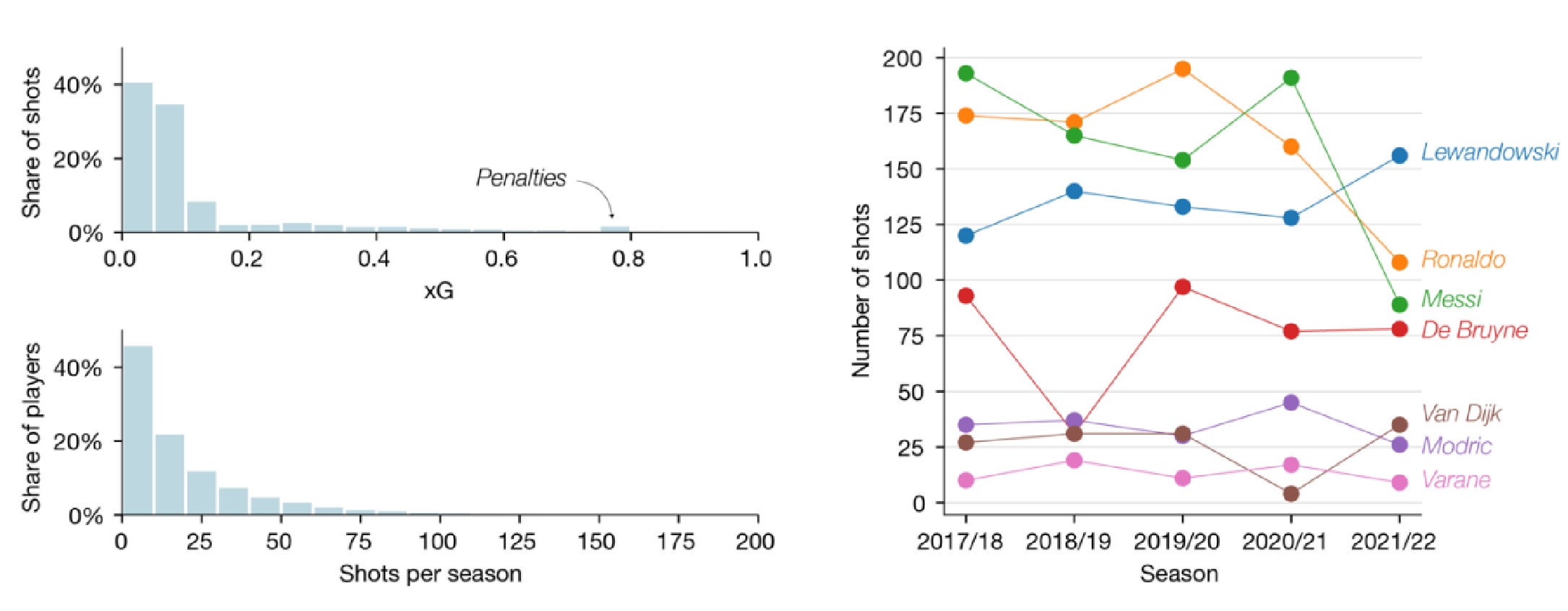
To quantify the problem, the authors train a logistic regression xG model on 43,110 open-play shots from the 2015/16 Big Five leagues in StatsBomb Open Data. They then simulate shooters with different true finishing levels and shot volumes, repeating each setting 10,000 times.
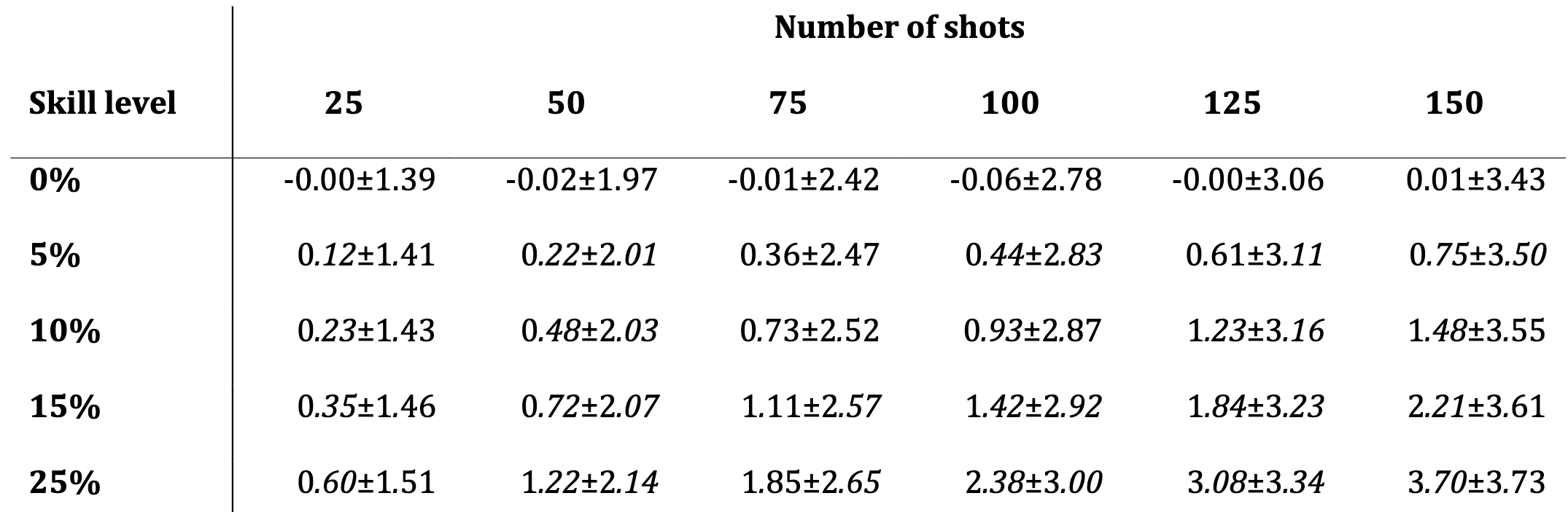
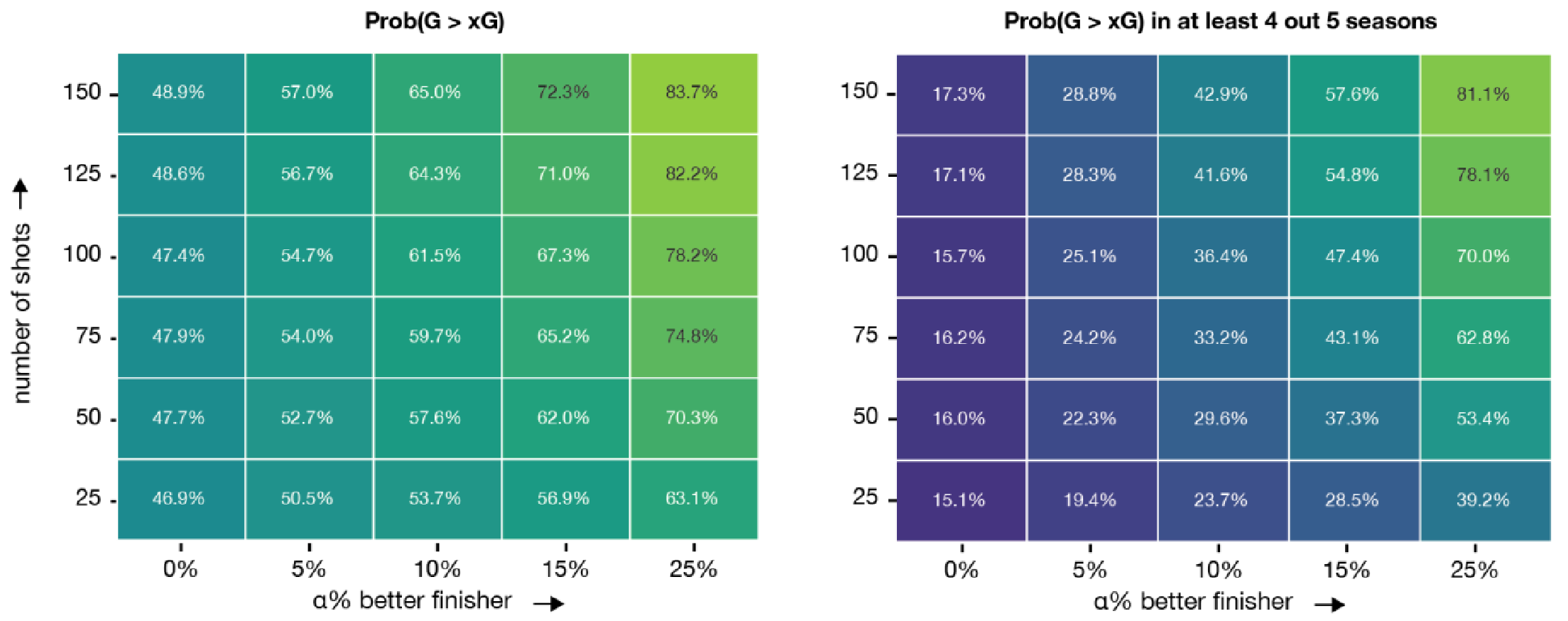
Figure 2 shows that even genuinely strong finishers cannot be expected to beat xG every season. A player who finishes 25% better than average and takes 100 shots per season has a 70% chance of outperforming xG in at least four of five seasons. If the advantage falls to 10%, even at 125 shots per season, that probability drops to 41.6%. The variance around GAX also remains substantial, meaning prolonged overperformance usually requires both exceptional finishing and high volume.
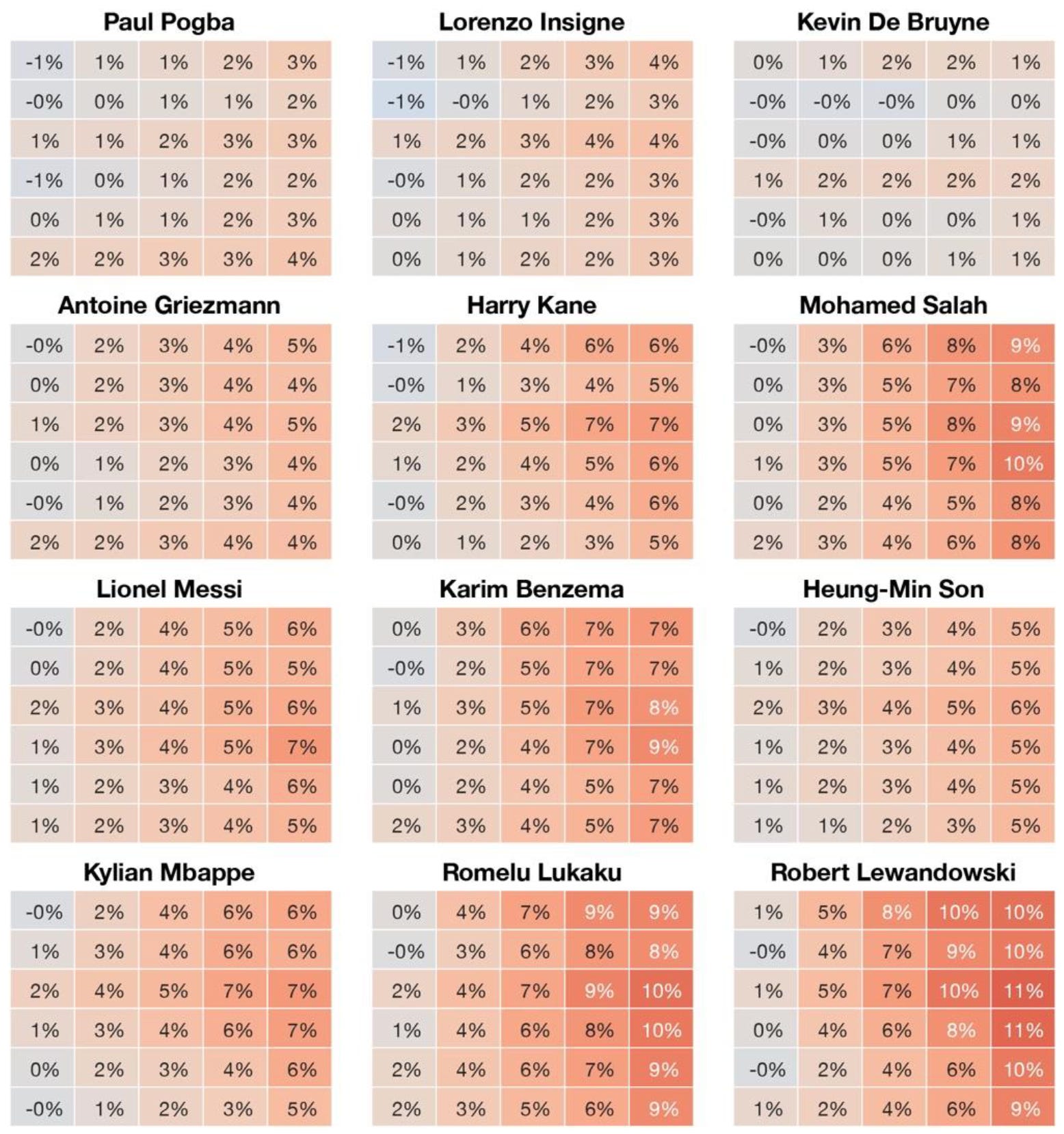
Shot selection matters too. When the simulations use the real shooting profiles of players such as Kane, Lewandowski, Mbappé, Messi and Salah, these players generally have a higher probability of outperforming xG because of where they tend to shoot from. GAX therefore reflects both finishing ability and the distribution of chances a player takes.
Hypothesis 2: Including all shots when computing GAX is incorrect and obscures finishing ability.
Finishing is not necessarily one single skill. Heading, footed finishing and long-range shooting may require different abilities, meaning aggregating them into one GAX figure can hide meaningful strengths and weaknesses. Yet separating them also reduces already small samples.
Some attempts may not represent finishing skill well at all. Speculative shots forced by game state or deflected attempts can be heavily influenced by circumstances outside the player’s control.
Paul Pogba illustrates the problem. Across 242 open-play Premier League shots between 2017/18 and 2021/22, he scored 17 goals from 20.85 xG, suggesting below-average finishing overall. However, when the analysis is restricted to shots from 25 to 35 yards, he statistically outperforms xG. Looking season by season, though, the sample becomes too small for strong conclusions.
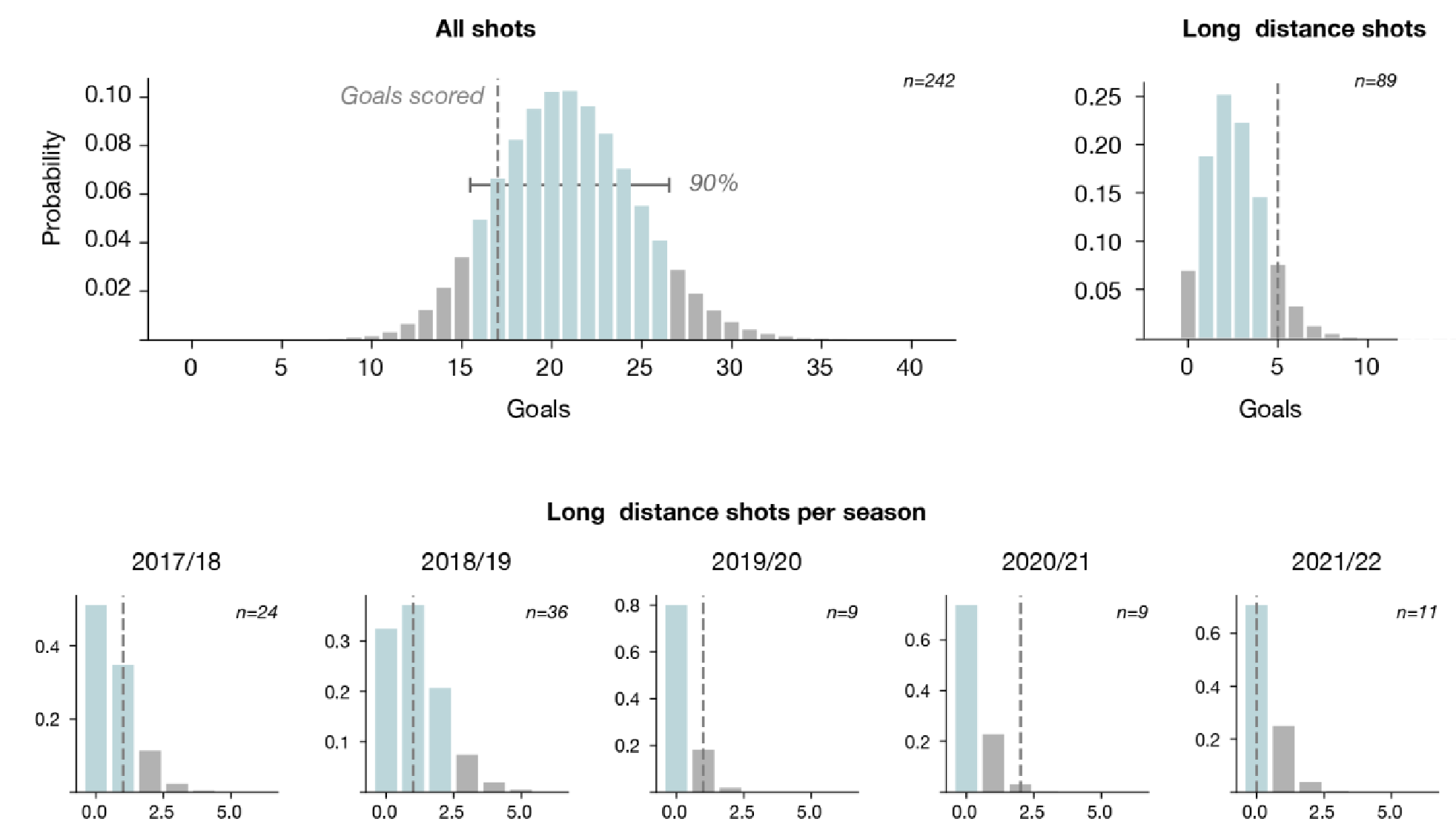
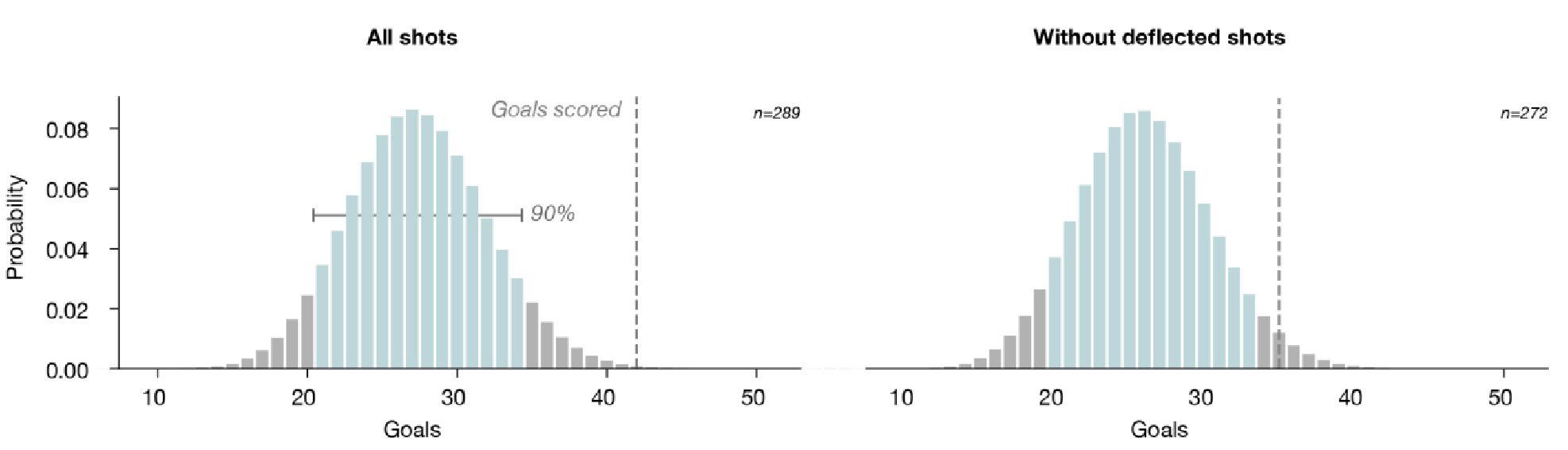
Deflections can also meaningfully change results. Riyad Mahrez accumulated 14.61 GAX across 289 shots during the same period, but only 9.03 when 17 deflected attempts were removed. Even rare shot types can therefore have a large effect on individual finishing estimates.
Hypothesis 3: Interdependencies in the data bias GAX.
The third hypothesis concerns how xG models are trained. Consider Lionel Messi. If an xG model is trained on hundreds of thousands of European shots, hundreds of those attempts may come from Messi himself. Because he converts certain shots unusually well, the model can learn slightly higher probabilities for situations similar to those he frequently encounters. Some of his finishing skill is therefore absorbed into the expectation against which he is later evaluated.
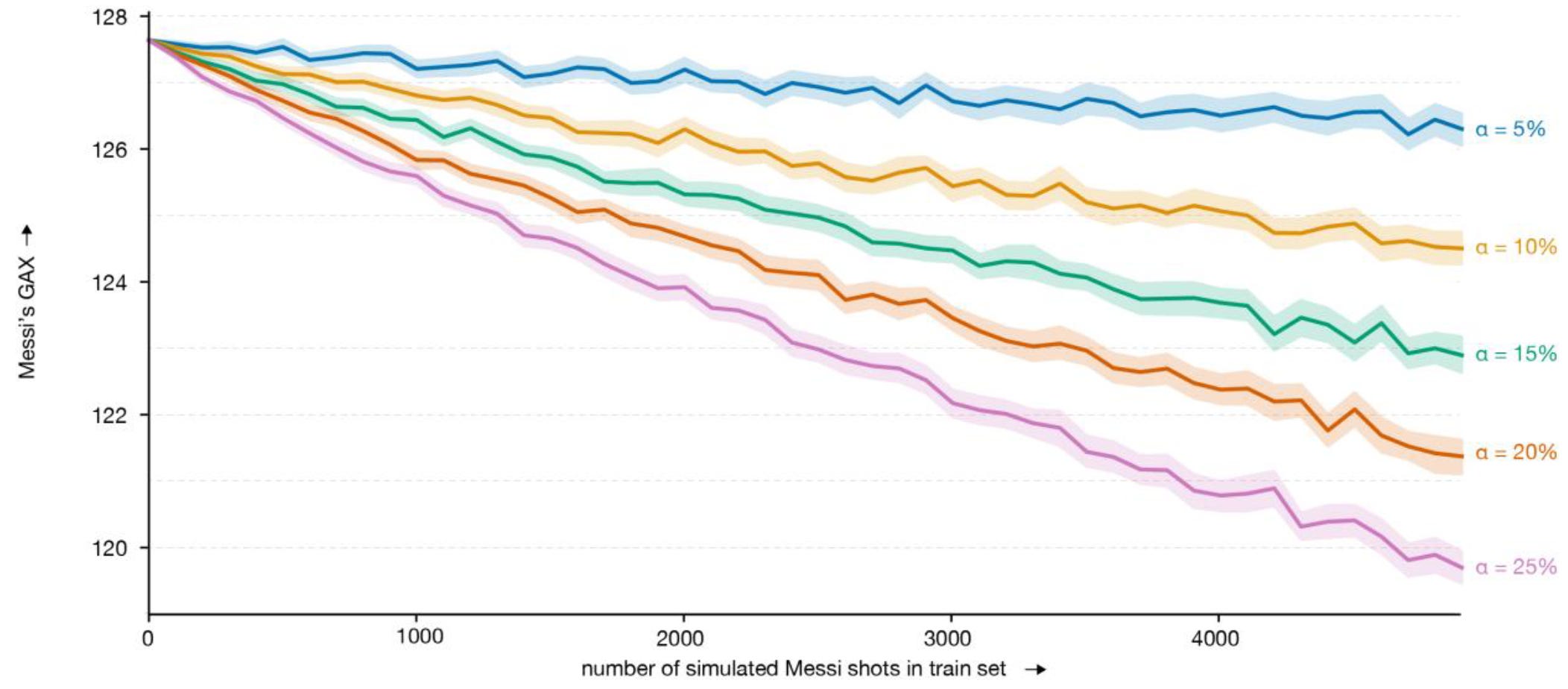
The authors test this by starting with an xG model trained without Messi and progressively adding simulated attempts from above-average finishers. As stronger shooters make up more of the training data, Messi’s calculated GAX decreases. Adding 4,000 shots from players who finish 25% better than average reduces his GAX from 127.6 to 120.8.
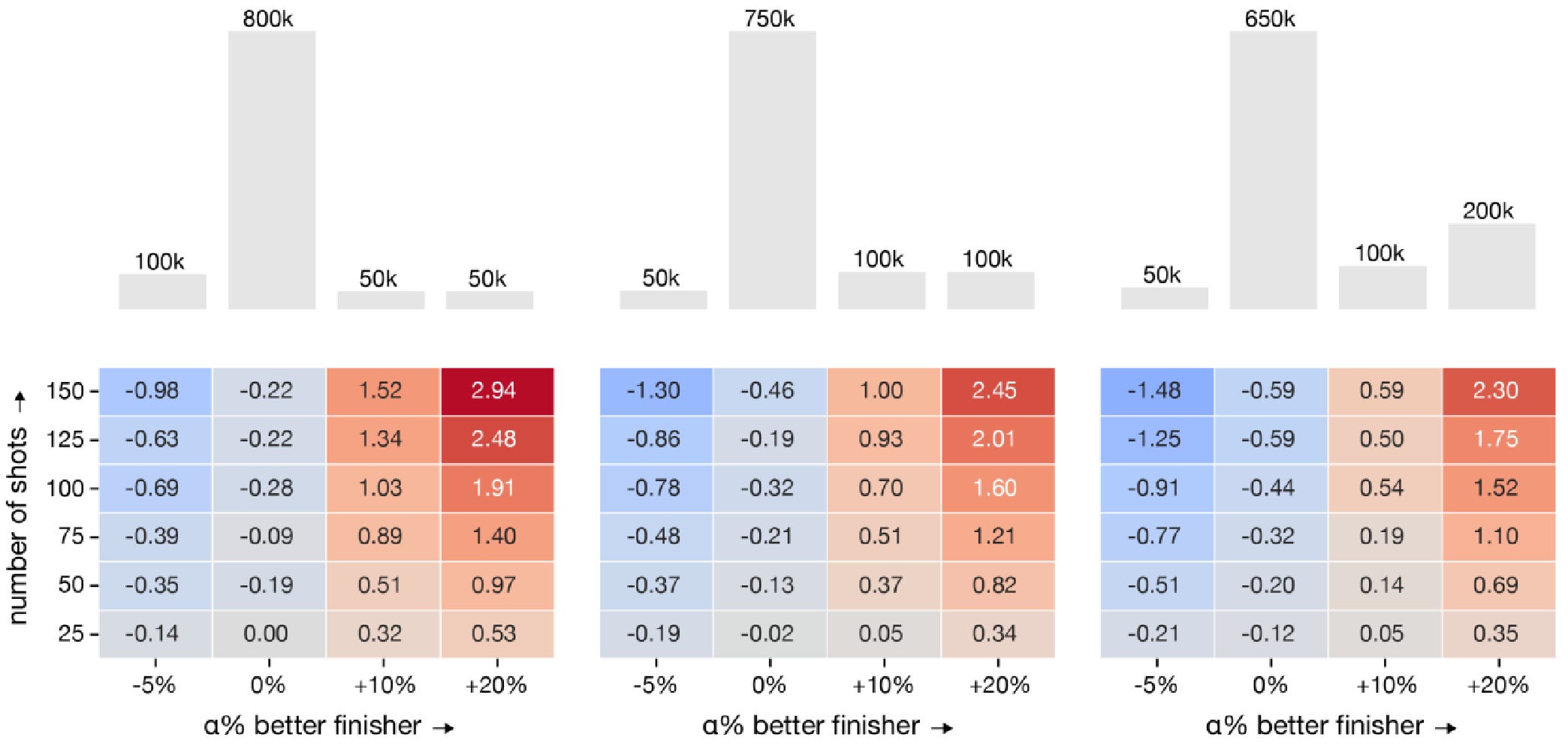
A larger simulation with one million shots confirms the same pattern. When excellent finishers contribute a greater share of the training data, the expected probabilities increase and the measured GAX of strong finishers falls. The supposedly “average player” represented by xG is therefore influenced by who appears most often in the dataset.
3. Finishing Skill through the Lens of AI Fairness
The central issue is that conventional xG calibration does not necessarily produce an appropriate baseline for measuring skill. A standard model tries to reproduce the observed scoring frequencies in the data. But if high-volume shooters are also better finishers, faithfully modelling those data can cause the system to “overestimate the finishing skill of poor finishers and underestimate the skill of great finishers.”
The authors connect this problem with fairness research in machine learning [13], where models are often evaluated across different population subgroups. Their goal is not traditional group calibration, however. If a player really is better than average, the model should preserve that difference rather than calibrating it away.
Finishing skill itself is unobserved, so the paper proposes three proxies for dividing players into meaningful groups. The first is shot volume, based on the assumption that good shooters tend to take more attempts. The second is playing position, separating defenders, midfielders and attackers. The third is team strength, using Club Elo to distinguish stronger and weaker clubs.
The calibration results support some of these distinctions. Low-volume shooters generally underperform conventional xG, while high-volume shooters slightly outperform it. Defenders also tend to underperform, whereas midfielders and attackers are reasonably well calibrated for lower-value chances. Team-strength differences are smaller.
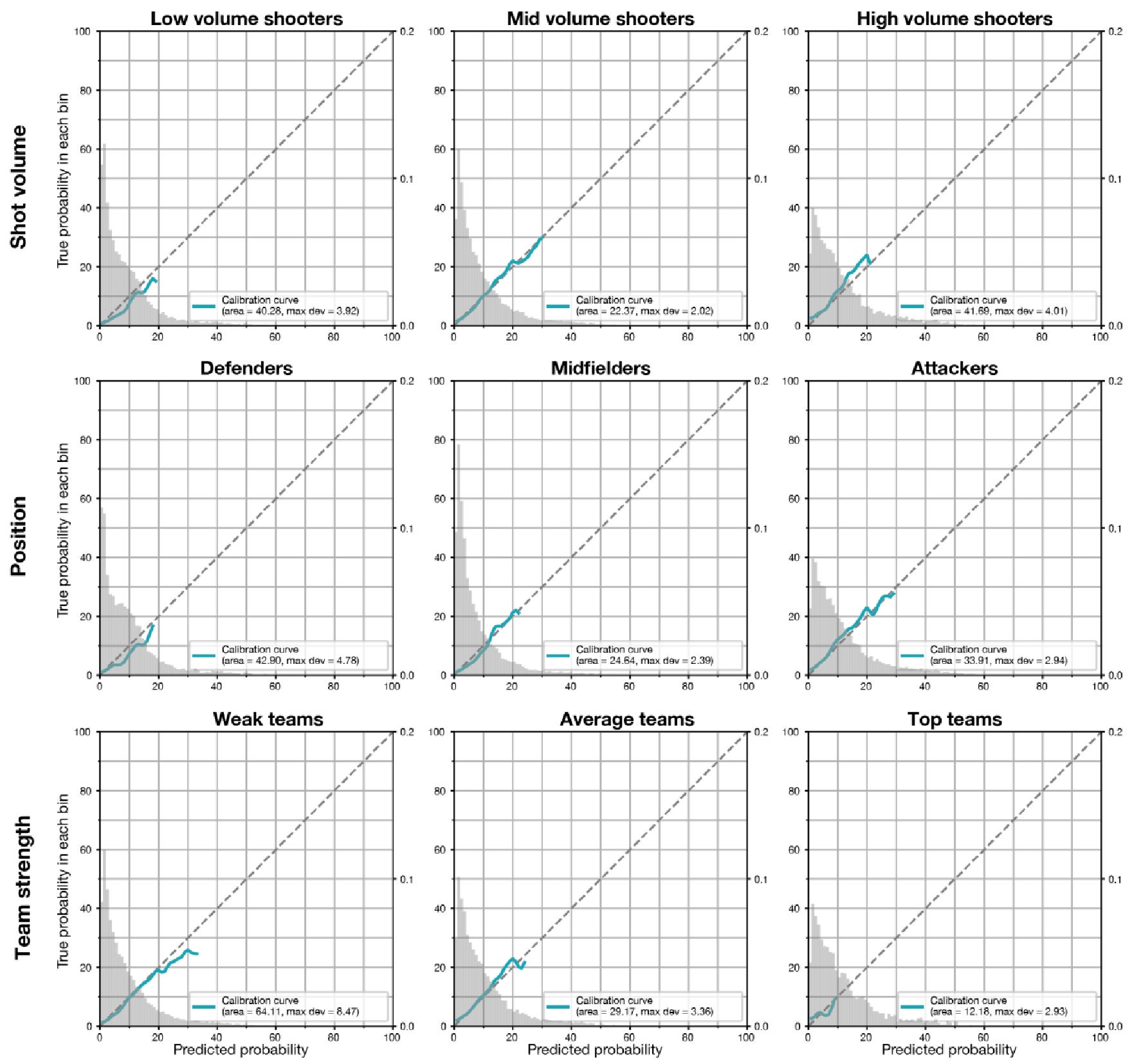
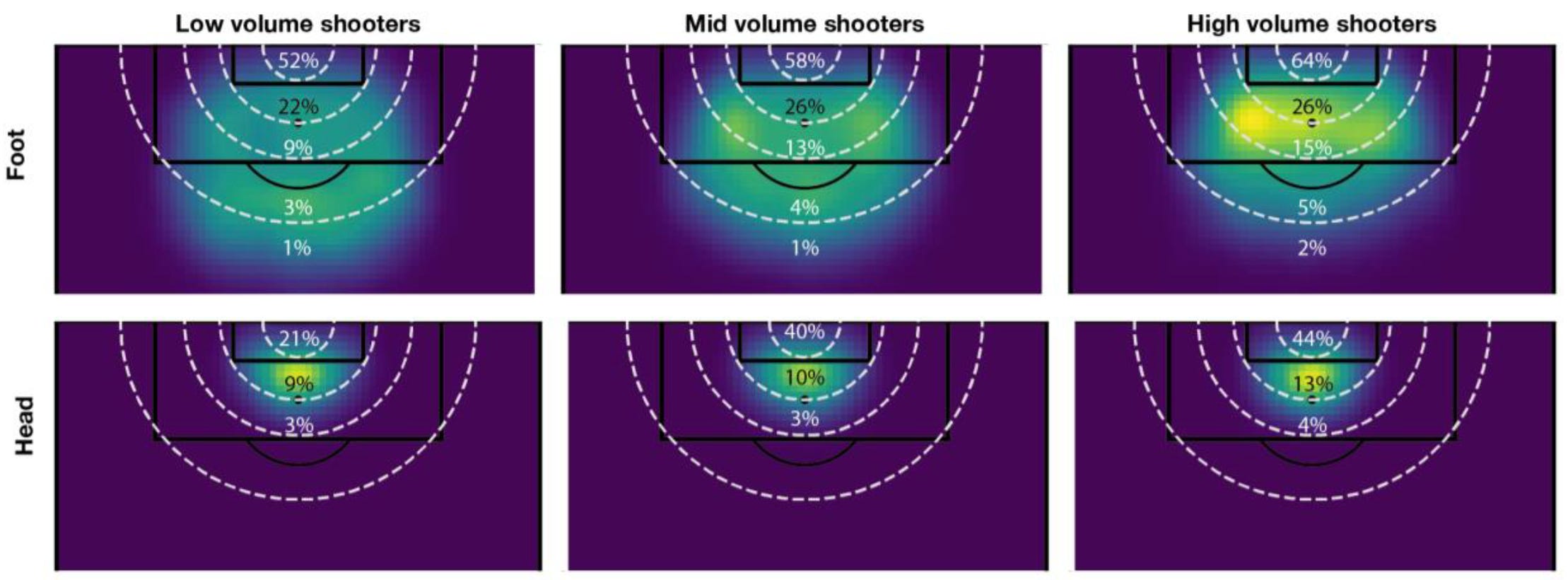
Figure 9 provides further evidence for shot volume as a useful proxy. Across several distance bands, high-volume shooters consistently record higher conversion rates than medium-volume players, who in turn outperform low-volume shooters. This pattern appears for both headers and footed shots.
To model these differences explicitly, the authors use multi-calibration [14]. Rather than relying on one universal “average player”, the approach produces calibrated expectations for intersections of shot volume and playing position, creating nine different baselines. Analysts can therefore compare a player with a high-volume attacker, low-volume midfielder or another clearly defined reference group.
Messi demonstrates the consequences. In the StatsBomb biography data, he scored 375 goals from 1,862 open-play shots. The standard logistic model gives him 247.43 xG, close to StatsBomb’s 246.00. Comparing him specifically with high-volume attackers raises his expected total to 274.3, creating a tougher elite benchmark.
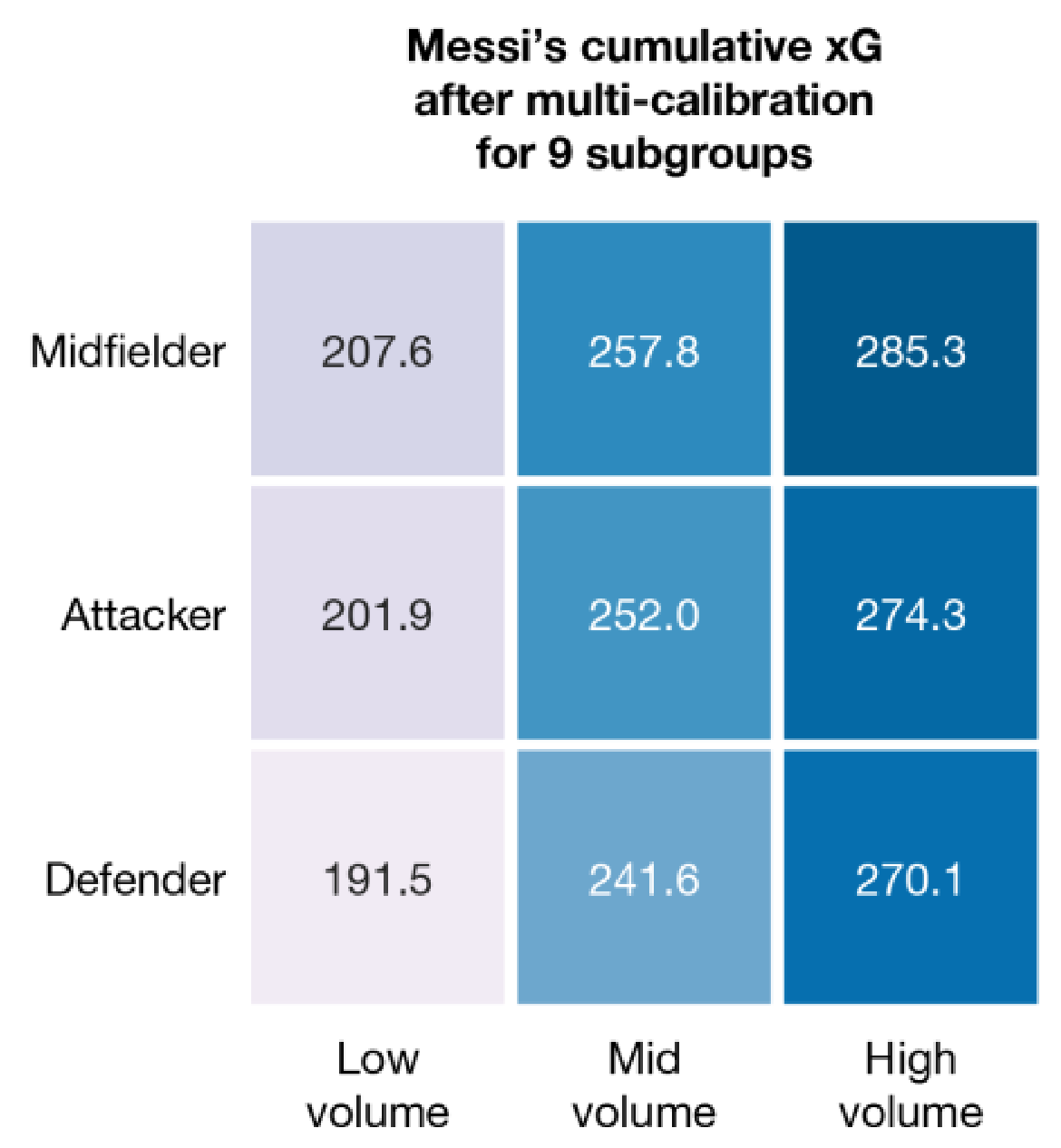
However, when the nine groups are weighted into a broader representation of the average player, Messi’s expected total falls to 225.01. His GAX increases from 127.57 to 149.99, approximately 17%. The standard model therefore appears to understate how exceptional his finishing is because elite shooters are overrepresented in the original training data.
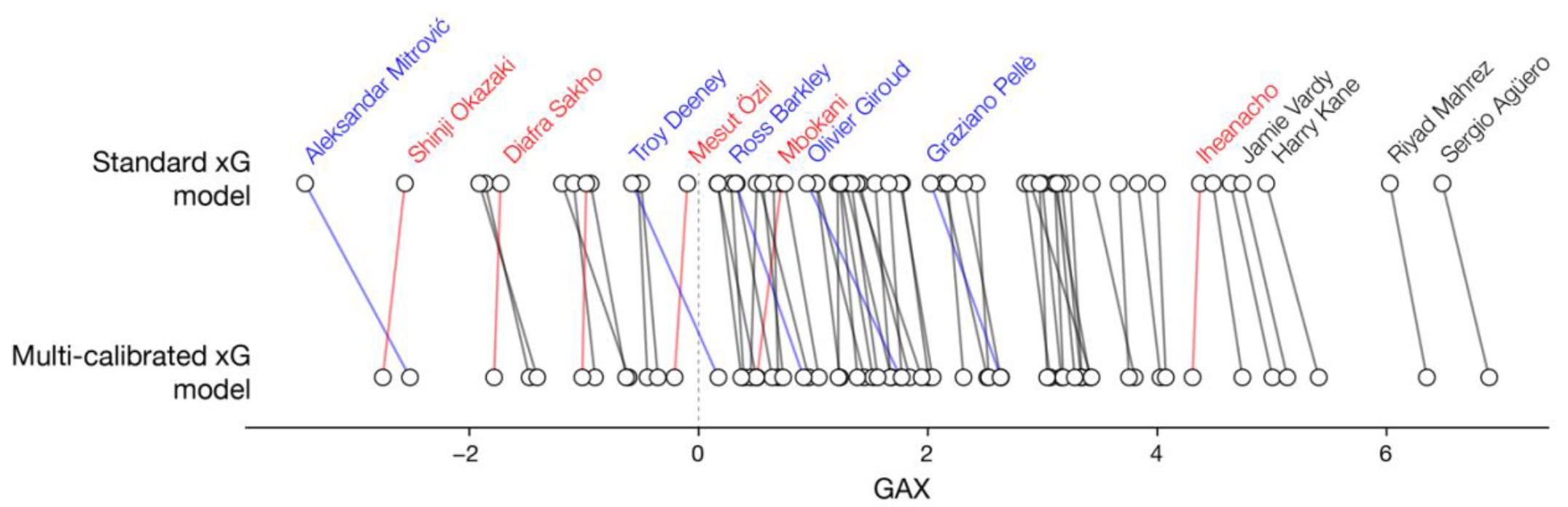
A similar analysis of the 2015/16 Premier League shows that players scoring at least five goals tend to outperform the multi-calibrated xG baseline by more than the conventional model. The absolute GAX values change noticeably, although the ranking of players changes much less.
4. Related Work
Before xG, finishing was commonly assessed through shot conversion rates. This approach ignores chance quality and can be biased because stronger shooters often take more shots. Gregory [15] and Shaw [16] address some of these issues through empirical Bayesian approaches.
Other work models finishing ability directly. Kwiatkowski [17] uses Bayesian logistic regression with player-specific effects inside an xG model, while Arslan [18] develops a similar approach focused specifically on Messi. Bayesian modelling also provides uncertainty around estimated player effects, helping distinguish genuine skill from noise.
Researchers have also noted that cumulative xG is only a point estimate. The same total can come from very different collections of shots, so methods based on the full distribution of possible goal totals can provide more information [11], [19].
Post-shot xG models [20], [21] incorporate where the ball travels after it is struck, while newer approaches assign value even to off-target attempts [22], [23]. These methods increase the information available for evaluating finishing, but because they are trained on similar populations of shots, they may still inherit the same biases identified in this paper.
5. Discussion
The paper’s broader point is that an xG model does not automatically represent an abstract “average player”. It represents the observed distribution of the data used to train it. Because high-volume shooters contribute more attempts, they receive more weight in the learned probabilities. If these players are also better finishers, part of their skill becomes embedded in the baseline itself.
This creates a tension between prediction and skill evaluation. For prediction, accurately reproducing the observed scoring probabilities is desirable. For measuring finishing ability, however, analysts need an explicit comparison population. Multi-calibration provides one way to construct those baselines using characteristics such as position, role or competition level.
Even with a better baseline, finishing remains difficult to estimate. Differences in genuine ability are often small relative to the variance of shot outcomes, so only players combining high volume with exceptional finishing are likely to show persistent xG overperformance.
What counts as a valid shot also matters. Heading, long-range shooting and footed finishing may need to be considered separately, while deflections and speculative attempts may not accurately reflect finishing ability at all. Yet every additional subdivision reduces sample size and increases uncertainty.
Practically, the authors argue that the purpose of the model should determine how xG is built and interpreted. Standard xG remains suitable for describing chance quality and shot selection. Evaluating player skill requires more care over what “average” means, which shots are included, and which players generated the training data. Dataset composition can materially change GAX, particularly if finishing skill differs across leagues or competitions.
More complex models may even absorb more of these biases because they can fit subtle patterns in the observed data more closely. A stronger predictive model is therefore not necessarily a better benchmark for measuring player skill. Overall, GAX remains useful, but its interpretation should account for outcome variance, shot selection and the composition of the data underlying the xG model.
Learn More
Here you have a direct link to get the free xG Mini-Guide, suited for those who want to fully understand the model in 5 minutes.


References
Davis, J., & Robberechts, P. (2024). Biases in expected goals models confound finishing ability. arXiv preprint arXiv:2401.09940.
https://arxiv.org/abs/2401.09940
the point about training data shaping the baseline is the one people skip. does the paper suggest a fix for high volume shooters, or is it mainly a warning?