


1 Introduction
The paper discussed today addresses the challenge of estimating the Expected Possession Value (EPV) in soccer, a critical problem given the sport’s complex, spatiotemporal nature. The authors propose a flexible framework capable of evaluating diverse tactical scenarios, such as identifying goal-leading actions or defensive strategies. Their approach decomposes EPV into three fundamental actions—passes, ball drives, and shots—to better analyze their contributions. They offer deep learning models to estimate EPV components, tailored to either spatial probability surfaces or single-value predictions.
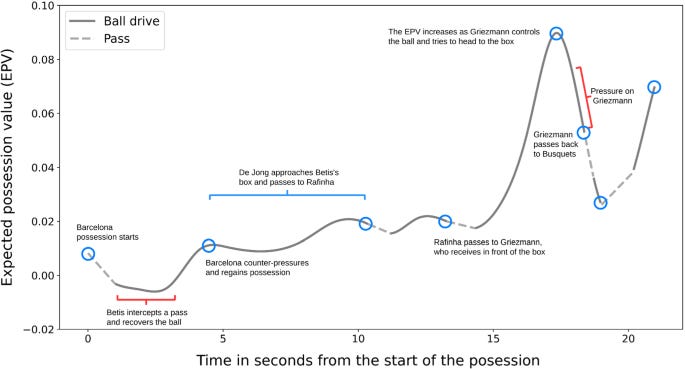
Key contributions include a comprehensive framework for evaluating possession value, improved interpretability through action decomposition, and the introduction of deep learning architectures for precise EPV estimations. Practical applications demonstrate the framework's potential to inform coaching strategies, enhancing soccer analytics and team performance.
2 Background
The paper emphasises the growing focus on evaluating soccer actions analytically, addressing challenges such as the low frequency of goals compared to other events like passes or turnovers. Earlier approaches relied on handcrafted features or machine learning algorithms with limitations in representing event data or addressing action variability.
The authors introduce an Expected Possession Value (EPV) framework that incorporates the spatial and temporal dynamics of players and the ball. This method evaluates both the value added by actions and the EPV at any moment. They draw parallels with similar advancements in sports like basketball and hockey, where spatiotemporal data has been leveraged for action valuation.
The use of event and spatiotemporal tracking data is pivotal. Event data captures key actions and outcomes during matches, while tracking data provides high-frequency spatial information about players and the ball. Combined, these datasets offer the foundation for building and validating the proposed EPV framework, allowing for more precise modeling of soccer dynamics.
3 Structured modeling
The paper details a structured approach to estimating the EPV by decomposing it into distinct subcomponents. This decomposition allows for tailored modeling of each component, improving interpretability and adaptability. EPV is framed as a Markov decision process (MDP), where the player in possession acts as an agent choosing discrete actions based on the current game state. This framework enables the estimation of long-term rewards from possession, factoring in probabilities of different actions.
3.1 Defining possessions in soccer
Possession is defined as a sequence of actions controlled by one team, starting with an initial state (e.g., kick-off) and ending with an absorbing state, such as a goal or half-time. Flexible time resets can be incorporated to adapt the definition to various analyses. The proposed definition acknowledges dynamic ball control exchanges and aligns with other action-value models.
3.2 EPV as a Markov decision process
In this framework, soccer possessions are modeled as trajectories in a high-dimensional space encompassing spatiotemporal and event data. The expected value of a possession at a given time integrates all potential future paths based on the current state. The game state is represented by spatiotemporal tracking data, while discrete actions and their probabilities are modeled as policy functions. The framework is designed to process synchronized spatiotemporal and event data, setting the foundation for detailed EPV estimation.
3.3 A decomposed model
EPV is decomposed into three fundamental actions: passes, ball drives, and shots. Passes are modeled with destination locations and transition probabilities, while ball drives and shots consider the likelihood of maintaining or transferring possession. Each component—pass success, turnovers, and shot expectations—is modeled separately and combined to estimate the EPV. This modular approach enhances analytical interpretability and aligns with soccer-specific concepts, aiding coaches in integrating data-driven insights into their strategies.
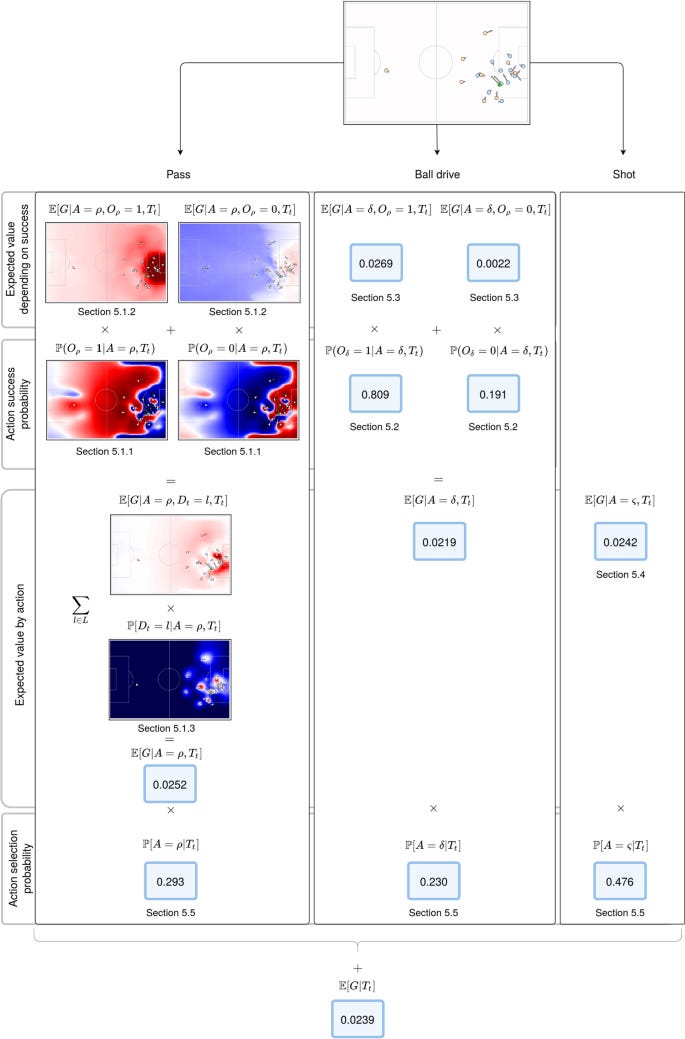
4 Spatiotemporal feature extraction
This section focuses on extracting features from tracking data to build a comprehensive representation of the game state, essential for estimating the components of the decomposed EPV. Features are categorized into two main types: spatial features, which directly describe player and ball positions, and contextual features, which incorporate advanced soccer-specific knowledge derived from game dynamics.
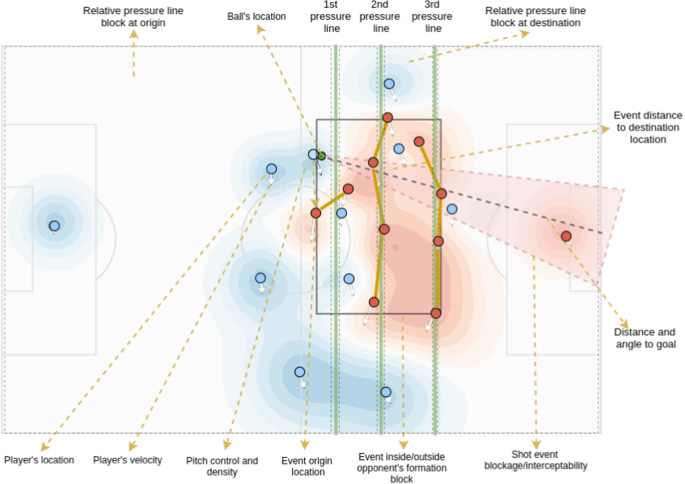
4.1 Spatial features
Spatial features are extracted from tracking data and include the locations and velocity vectors of players and the ball. These features describe player density, pitch control, and spatial arrangements on the field. Key aspects include understanding player movement patterns, control zones, and their potential influence on the game state. This information is foundational for modeling components such as passing, ball drives, and shot probabilities.
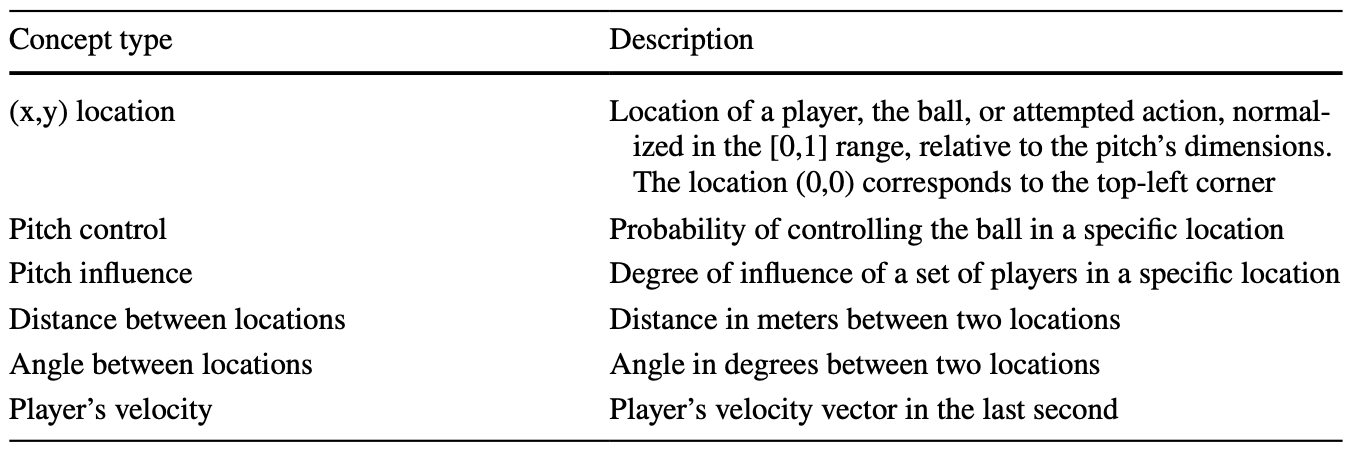
4.2 Contextual features
Contextual features extend the state representation by capturing tactical and strategic elements of the game. Dynamic pressure lines are introduced to identify players’ positioning relative to opponent formations, distinguishing attackers, midfielders, and defenders. Features like the number of outplayed opponents and pass directions help quantify the tactical value of breaking defensive lines. Additionally, concepts such as interceptability assess opponents’ ability to disrupt a pass or shot. These contextual features significantly enhance the understanding of player decisions and their impact on possession value.
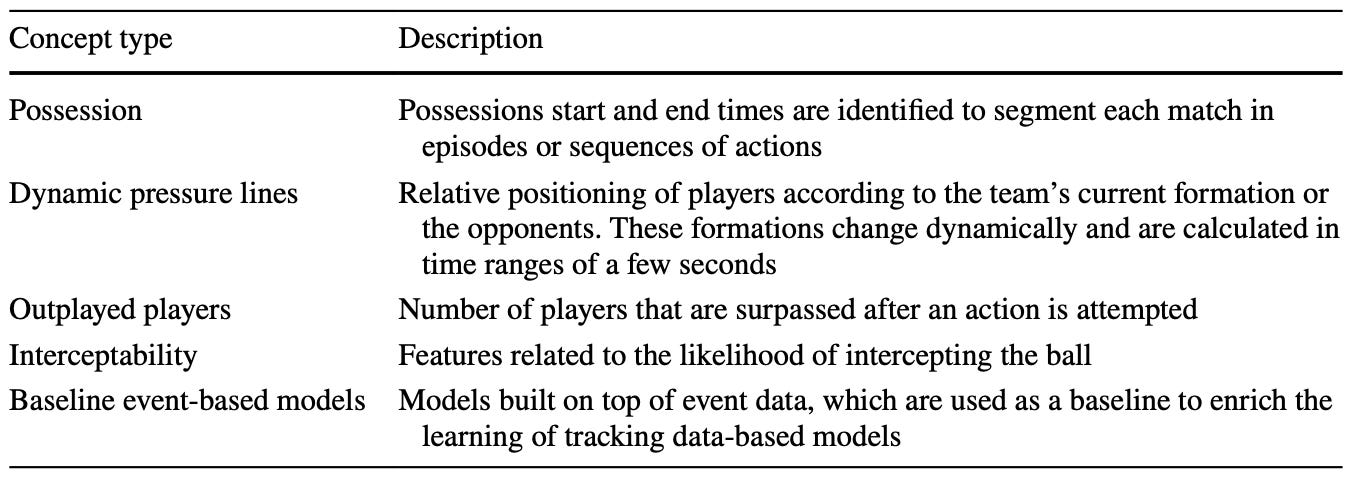
The extracted features form the input for the models used to estimate EPV components, providing a rich and nuanced representation of the game state that aligns with both spatial and tactical dimensions.
5 Separated component inference
This section describes the methods for estimating the components of the EPV using function approximation. Each component—pass success probability, expected value of passes, ball drives, and shots—is modeled independently to enhance flexibility and precision. The approach involves approximating a true function f* that maps features x to outcomes y. The model is defined as y=f(x;θ) and the goal is to learn the parameters θ to closely match f*.
5.1 Estimating pass impact at every location on the field
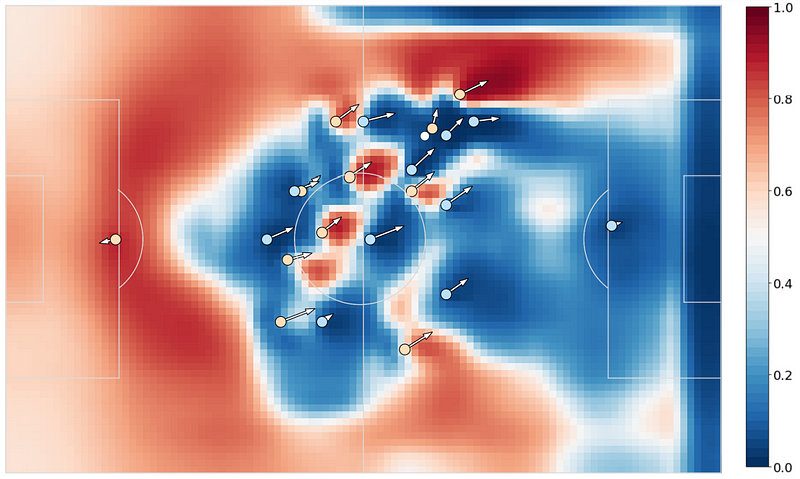
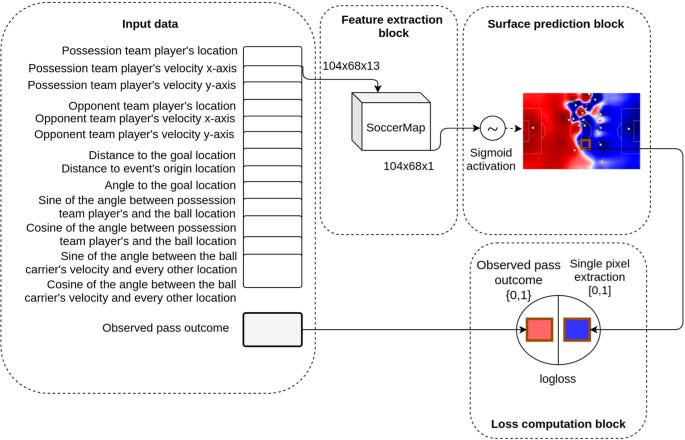
Modeling passes requires understanding spatial and contextual information influencing pass success, selection, and value. The authors employ fully convolutional neural networks to generate probability surfaces for pass success, selection, and expected value. Inputs are structured into layered matrices representing spatiotemporal data, processed by the SoccerMap architecture. Predictions are optimised via back-propagation on observed pass destination data, enabling models to learn full probability distributions across the field.
5.1.1 Pass success probability
This model estimates the likelihood of a pass reaching its target, factoring in spatial and contextual information such as player positions, velocities, and distances. The SoccerMap architecture generates predictions for all potential pass destinations, with probabilities refined using a sigmoid activation function and negative log-loss optimisation.
To learn more about SoccerMap read my previous article:
5.1.2 Expected possession value from passes
This model evaluates the impact of successful and unsuccessful passes on possession value. It incorporates additional contextual features like pressure lines and outplayed opponents, alongside a pre-trained pass probability surface. Predictions are scaled to the range [−1,1], with training optimised via mean squared error loss between observed and predicted values.
5.1.3 Pass selection probability
Pass selection probability models estimate the likelihood of a player choosing a particular pass option. Similar to the success probability model, this architecture uses a softmax activation function to ensure outputs sum to one. Training involves computing log-loss between observed passes and predicted probabilities. This integration supports a comprehensive estimate of EPV for pass actions.
5.2 Estimating ball drive probability
Ball drive probability models predict the likelihood of maintaining possession during a ball drive. A shallow neural network is used, with features capturing opponent pressure, team density, and pitch control near the ball carrier. This model emphasizes the contextual risk of losing possession during a ball drive.
5.3 Estimating ball drive expectation
This model predicts the expected value of maintaining possession during ball drives, incorporating the probability of success and contextual features. Outputs are scaled to the range [−1,1], with training focused on minimizing the mean squared error between observed outcomes and predictions.
5.4 Expected goals model
The expected goals (xG) model estimates the probability of scoring from a shot, accounting for spatial and contextual features such as player positions, goalkeeper location, and shot interceptability. A standard neural network architecture is trained to minimize mean squared error between predicted and observed outcomes.
5.5 Action selection probability
Action selection probability models estimate the likelihood of choosing between passes, ball drives, and shots at any game state. Spatial and contextual features guide predictions, with a softmax activation function ensuring probabilities sum to one. Training minimizes categorical cross-entropy between predicted and observed actions.
By decomposing EPV into these distinct components, the framework supports precise modeling of soccer actions, enabling more interpretable and actionable insights into game dynamics.
6 Experimental setup
6.1 Datasets
The dataset includes tracking and event data from 633 English Premier League matches across the 2013/2014 and 2014/2015 seasons, provided by STATS LLC. Tracking data provides player and ball locations at a 10Hz sampling rate, while event data includes labeled on-ball actions like passes, ball drives, and shots. Success definitions vary by action: passes are successful if received by a teammate, ball drives if possession is maintained, and shots if they result in a goal.
Tracking snapshots are extracted for each event, normalized to ensure the attacking team always moves left to right. These snapshots form the input features for models, aligning with definitions outlined earlier. Data preparation focuses on isolating meaningful open-play sequences for accurate analysis and modeling.

6.2 Defining the estimands
Each EPV component corresponds to distinct outcomes. Pass and ball drive success probabilities are modeled as binary outcomes, while action selection probabilities are multinomial. EPV estimations use long-term rewards, tied to the outcomes of entire possessions, such as scoring or conceding. Possessions are capped at 15 seconds beyond the last action to limit their temporal extent, given soccer’s low goal frequency. Actions occurring within 5 seconds of set-pieces (e.g., free-kicks, corners) are excluded from open-play models, although set-piece goals remain included for completeness.
6.3 Model setting
The dataset is divided into training (379 matches), validation (127 matches), and test (127 matches) sets. Events are randomly shuffled to reduce temporal correlations. Training uses the adaptive moment estimation (Adam) optimizer, with β1=0.9 and β2=0.999. Hyperparameters, including learning rate ({1e−3,1e−4,1e−5,1e−6}) and batch size ({16,32}), are tuned via grid search. Early stopping is employed to prevent overfitting, using a predefined delta (1e−3 or 1e−5) for convergence.
6.4 Model calibration
Calibration, particularly for pass success and selection models, ensures reliable probability estimates. Temperature scaling adjusts logits by a constant Tp during the validation phase, correcting observed imbalances while preserving the relative probability distribution. This step enhances model interpretability and prediction reliability.
6.5 Evaluation metrics
Binary models (e.g., pass success probability) use cross-entropy loss to evaluate predictions against ground truth, while EPV models (range [−1,1]) employ mean squared error (MSE). Calibration accuracy is assessed via Expected Calibration Error (ECE), which partitions predictions into bins and calculates the weighted difference between predicted and observed outcomes. These metrics ensure model robustness and alignment with practical soccer scenarios.
6.6 Results
The study evaluates the performance of the proposed EPV models and their components using various metrics. Results are tabulated, highlighting loss values, optimal parameters, model complexity, and prediction speeds.
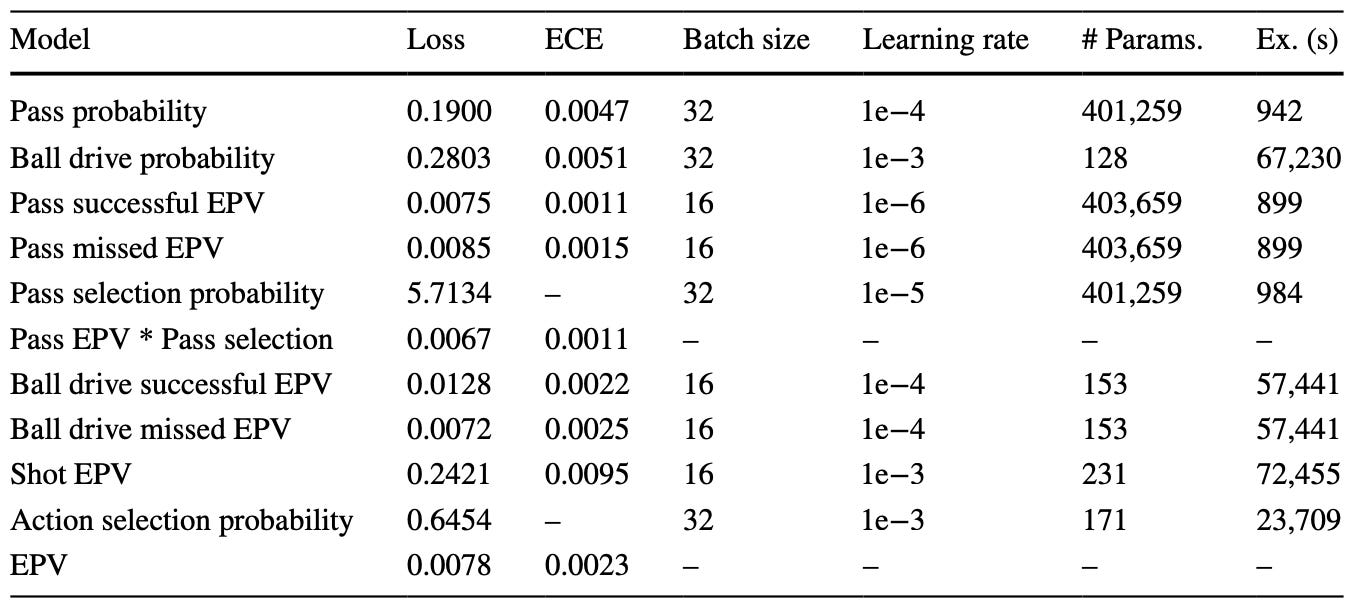
The joint EPV model exhibits consistent loss values across individual EPV components, demonstrating stability in the overall framework. However, shot EPV loss is relatively higher, attributed to the scarcity of observed shot events compared to passes and ball drives. The models deliver real-time prediction speeds, significantly exceeding the 10Hz sampling rate of tracking data, making them suitable for live match analysis.
Calibration is integral to the evaluation. Low Expected Calibration Error (ECE) values indicate well-calibrated probability estimates across the prediction range. Differences in calibration across models reflect the varying difficulty levels of soccer actions. For instance, keeping possession is generally easier than attempting a pass.
The calibration plots for the joint EPV model validate the effectiveness of the decomposition approach, integrating individually calibrated components into a coherent overall estimate. Post-training calibration further improves individual model accuracy, enhancing the reliability of the final predictions.
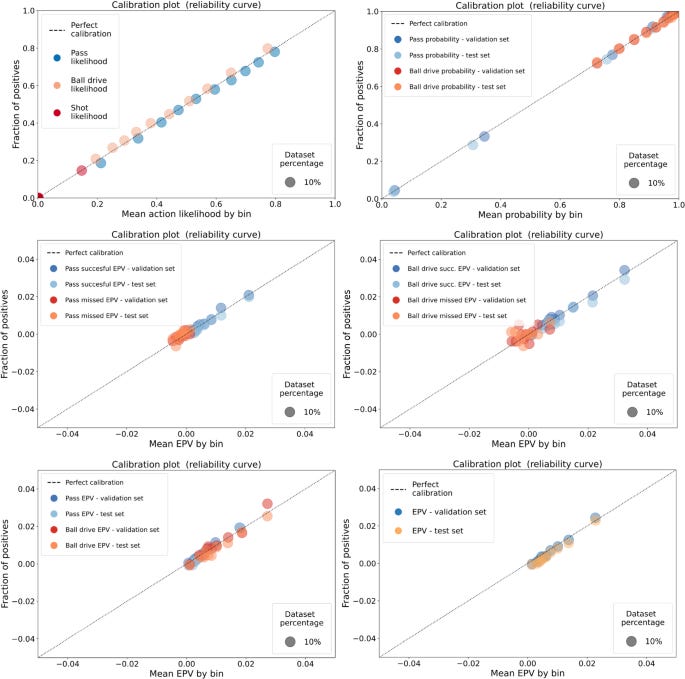
Overall, the results highlight the framework's robustness in providing precise long-term reward estimations and detailed evaluations of underlying components. This positions the EPV models as a valuable tool for soccer analytics.
7 Practical Applications
The proposed Expected Possession Value (EPV) framework provides actionable insights into soccer gameplay by quantifying the value of individual actions and scenarios during a match. It enables nuanced analysis of risks and rewards for specific actions and contextual features.
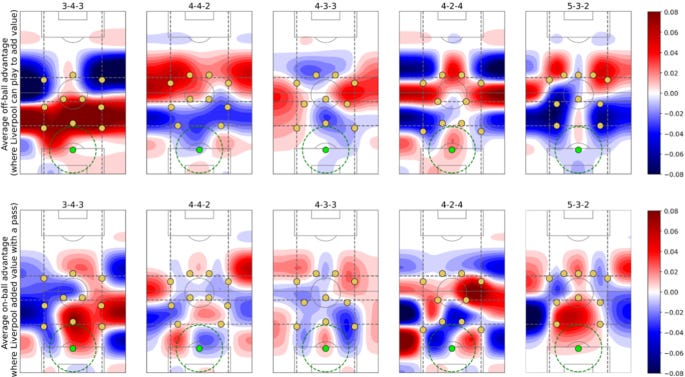
For instance, the framework assesses the influence of passes and pressing scenarios, demonstrating how disrupting Liverpool's buildup can be strategized effectively.
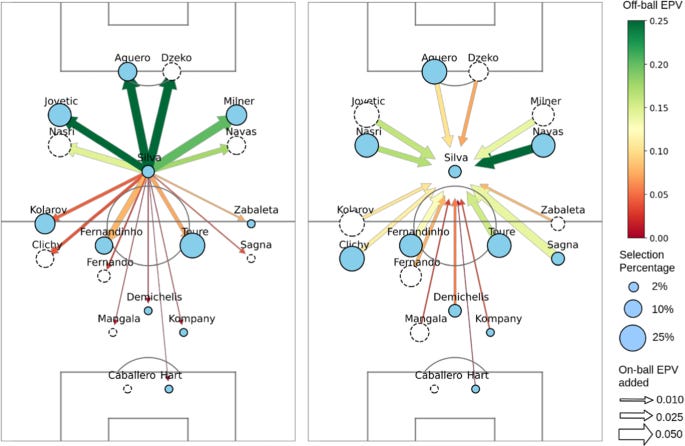
Another key application involves evaluating player contributions. The paper analyzes the 2014/2015 season performance of Manchester City, focusing on David Silva. By calculating on-ball and off-ball EPV contributions and examining his interactions with teammates, the framework identifies optimal configurations for maximizing his impact. These insights can guide team strategies and enhance player utilization.
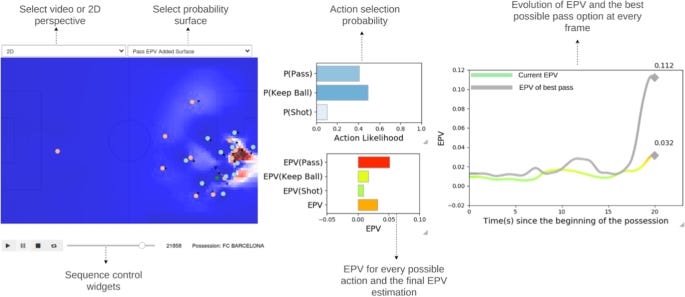
Moreover, the authors present a real-time control room application for coaches, integrating EPV components with visual tools for in-game decision-making. This tool enables dynamic analysis of possession development and provides actionable feedback to players regarding optimal decisions, such as passing to maximize possession value.
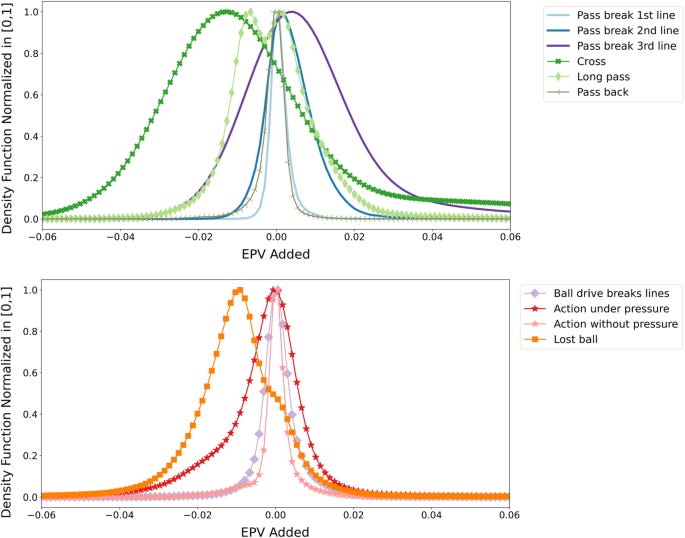
The EPV framework also highlights the diverse value distributions of soccer actions, such as passes breaking defensive lines, ball drives, and crosses. It identifies high-value actions and scenarios while quantifying the impact of pressure and spatial dynamics on outcomes. By doing so, it offers coaches valuable insights into team strategy, action prioritization, and risk management in different match contexts.
8 Discussion
The study presents a comprehensive framework for estimating the Expected Possession Value (EPV) in soccer, breaking it into distinct statistical components for a nuanced analysis of their contributions. By employing tailored models for each sub-component, the framework enhances precision and interpretability, offering a departure from generalized approaches. The deep learning architectures utilized produce probability surfaces that enrich visual analysis, providing coaches with actionable insights into player and team performance.
The decomposed EPV framework enables calibrated and precise estimations across components, such as pass success probability and possession value, ultimately producing a single actionable metric. Its integration of novel spatial and contextual features enhances the depth of game-state representation, offering rich, data-driven insights into soccer's complex dynamics.
Practical applications underscore the framework's utility in addressing diverse coaching challenges, such as evaluating player performance, tactical analysis, and scouting. The ability to visualize and quantify player contributions, alongside contextual insights into game scenarios, empowers coaches with data-driven strategies for pre- and post-match evaluations. The framework also opens avenues for future research, including young player development, match highlight detection, and tactical analysis for various leagues.
Overall, the framework demonstrates its potential to elevate soccer analytics, providing practitioners with a robust tool for understanding and communicating the intricacies of the game.
9 Limitations and Future Work
This study identifies several limitations in the current EPV framework, proposing pathways for improvement and future research. A primary limitation is the exclusion of player- and team-specific features, such as individual passing accuracy or team-level tactical tendencies, which could refine the model's context-specific predictions. However, incorporating these features may complicate the attribution of value, presenting challenges for interpretation.
The inclusion of meta-information, such as match importance, scoreline, or mental pressure, could significantly enhance the estimation of EPV by embedding richer contextual insights. Expanding the dataset beyond the English Premier League to encompass diverse leagues would improve the model’s generalizability, capturing broader variations in playstyles and spatiotemporal dynamics. Incorporating more recent data could also reflect contemporary changes in soccer, such as higher physical demands and evolving tactical approaches.
Lastly, addressing set-piece actions separately from open-play events is suggested to refine the EPV model. Differentiating these contexts at the implementation level would enable more accurate modeling of the distinct dynamics associated with set-pieces versus open-play scenarios.
These proposed enhancements provide a roadmap for evolving the EPV framework, enabling more sophisticated and robust analyses in soccer analytics.
References
Fernández, J., Bornn, L., & Cervone, D. (2021). A framework for the fine-grained evaluation of the instantaneous expected value of soccer possessions. Machine Learning, 110(6), 1389–1427. https://link.springer.com/article/10.1007/s10994-021-05989-6
Learn More


My Recommended Books
