


The following summary critically reviews the research paper titled “Unveiling True Talent: The Soccer Factor Model for Skill Evaluation” by Alexandre Andorra and Maximilian Göbel. All data, figures, and analysis presented here are drawn from their original work; I do not claim any authorship or ownership of the content. This summary has been written to provide a concise and technically informed synthesis of the paper’s findings, methodologies, and implications, while maintaining fidelity to the authors’ intellectual contributions.
1 Introduction
Evaluating football players from raw statistics is difficult because observed performance mixes together individual ability and team strength. A striker playing for a dominant side may benefit from his environment, while another player’s numbers may underestimate his ability because he plays for a weaker team. The central question is therefore whether “it is the player who is carrying the team, or rather the team who is carrying the player.”
The Soccer Factor Model
The authors introduce the Soccer Factor Model (SFM), a Bayesian framework designed to separate these two components. It conditions observed performance on factors describing the player’s team and opponent, leaving an estimate of the player’s underlying skill, denoted by α.
Relation to Literature on Financial Asset Pricing
The idea comes from financial factor models following Fama and French (1992, 1993). In finance, investment returns can be explained partly by exposure to common market factors. The unexplained component, or α, can then be interpreted as the investment manager’s skill.
The SFM transfers this logic to football. Team strength represents the systematic factors, while the player’s α captures the part of performance that remains after controlling for them.
SFM: Contributions
The SFM can predict how a player is expected to perform in a match, quantify how much of his observed performance comes from individual skill rather than team strength, and compare players who have competed in different team environments.
Relation to Existing Literature on Sports Analytics
This comparison connects the framework to Wins Above Replacement (WAR), which evaluates a player’s contribution relative to a replacement-level alternative. Baumer et al. (2015), for example, define this benchmark as “the typical player that is readily accessible in the absence of the player being evaluated.”
Skill-/Performance Above Replacement
Rather than estimating wins, the authors introduce Skill Above Replacement (SAR) and Performance Above Replacement (PAR). PAR compares overall predicted performance against a replacement player, while SAR removes team differences and compares players based only on estimated individual skill.
2 SFM: The Model
The model assumes that Observed Performance (OP) is generated by player skill α and Team Performance (TP):
A Bayesian framework is used to estimate these components. This provides posterior distributions rather than only point estimates, making it possible to quantify uncertainty around player skill and incorporate reasonable prior knowledge.
2.1 Determining the Likelihood
Although the SFM can accommodate different performance measures, the empirical application focuses on strikers and uses goals scored per match.
Because three or more goals occur in only around 1.5% of player-match observations, the authors group all such cases together. The target therefore has four ordered categories:
An ordered logistic model then estimates the probability of falling into each scoring category.
2.2 Determining the DGP for Player-Skill and Team-Effort
The predictive structure separates individual skill from systematic differences in team strength. The latter controls for the environment in which a player’s observed performance was generated.
2.2.1 Team-Performance: The Factor Structure
Team performance is represented as a linear combination of contextual factors:
All factors are calculated using only information available before kick-off, maintaining a realistic prediction setting. Their purpose is to absorb differences between teams that might otherwise be incorrectly attributed to the player.
2.2.2 Player-Skill: More than just α
Rather than representing ability with a fixed player-specific intercept, the authors allow skill to evolve:

The first components describe baseline player talent. The remaining terms capture a maturity effect, separating fluctuations within seasons from longer-term changes across seasons.
These trajectories are estimated using Gaussian Processes, which can represent nonlinear career paths without manually specifying their shape. Because conventional GPs become computationally expensive with large datasets, the authors use Hilbert Space Gaussian Process approximations (HSGPs) (Riutort-Mayol et al., 2022).
Three temporal scales are represented: short- and medium-term variation within seasons and longer-term variation across seasons. This allows the model to capture effects ranging from temporary form, fatigue or small injuries to longer-term development and decline.
2.3 Setting Priors
The Bayesian model requires priors for team factors, player effects and temporal dynamics. The authors argue that domain knowledge can help constrain the model and identify unreasonable specifications. As a simple diagnostic, a model placing recognised “GOATs” deep in the lower end of the skill distribution would warrant investigation.
Priors are therefore applied to the factor coefficients, baseline player effects and the amplitude and lengthscale parameters controlling the HSGPs. The ordered logistic model also requires three cut-off points separating the four goal categories.
3 SFM Add-On: Skill and Performance Above Replacement
The model’s outputs are translated into two interpretable comparison metrics.
Performance Above Replacement (PAR) compares a player’s complete predicted performance with that of a hypothetical Replacement Level Player (RLP), constructed from the average predictions of a selected group of replacement players.
Skill Above Replacement (SAR) performs the same comparison using only the estimated α. Team differences are effectively set to zero, creating a hypothetical level playing field.
The distinction allows the SFM to separate two questions: how much better has a player actually performed than replacement level, and how much better is his estimated underlying skill once team strength is controlled for?
4 SFM: Empirical Application
The empirical application predicts the number of goals scored per match, although the authors stress that the framework can be adapted to other performance variables.
4.1 Data
The dataset is scraped from kicker and covers the Premier League, Bundesliga, Serie A and La Liga between 2000/01 and 2023/24. The full database contains 34,441 matches, 12,775 players and 94,228 goals.
The final modelling sample contains 144 selected strikers, more than 33,000 player-match observations and over 13,000 goals. For the replacement metrics, 42 players are classified as Elite Players and 102 as Replacement Level Players, although this distinction is introduced only after the SFM itself has been estimated.
Figures 1 and 2 show that elite players already outperform the replacement group unconditionally, particularly through a lower probability of finishing matches without scoring.
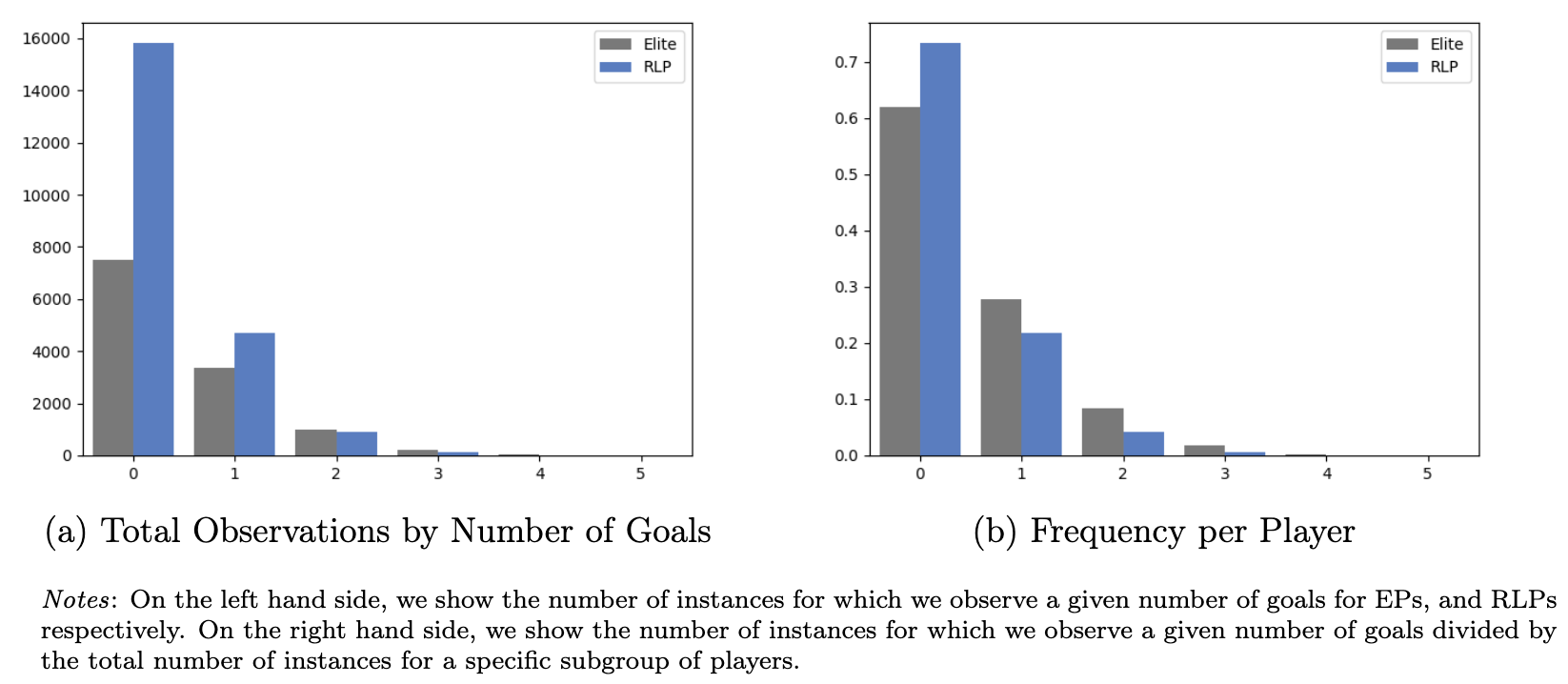
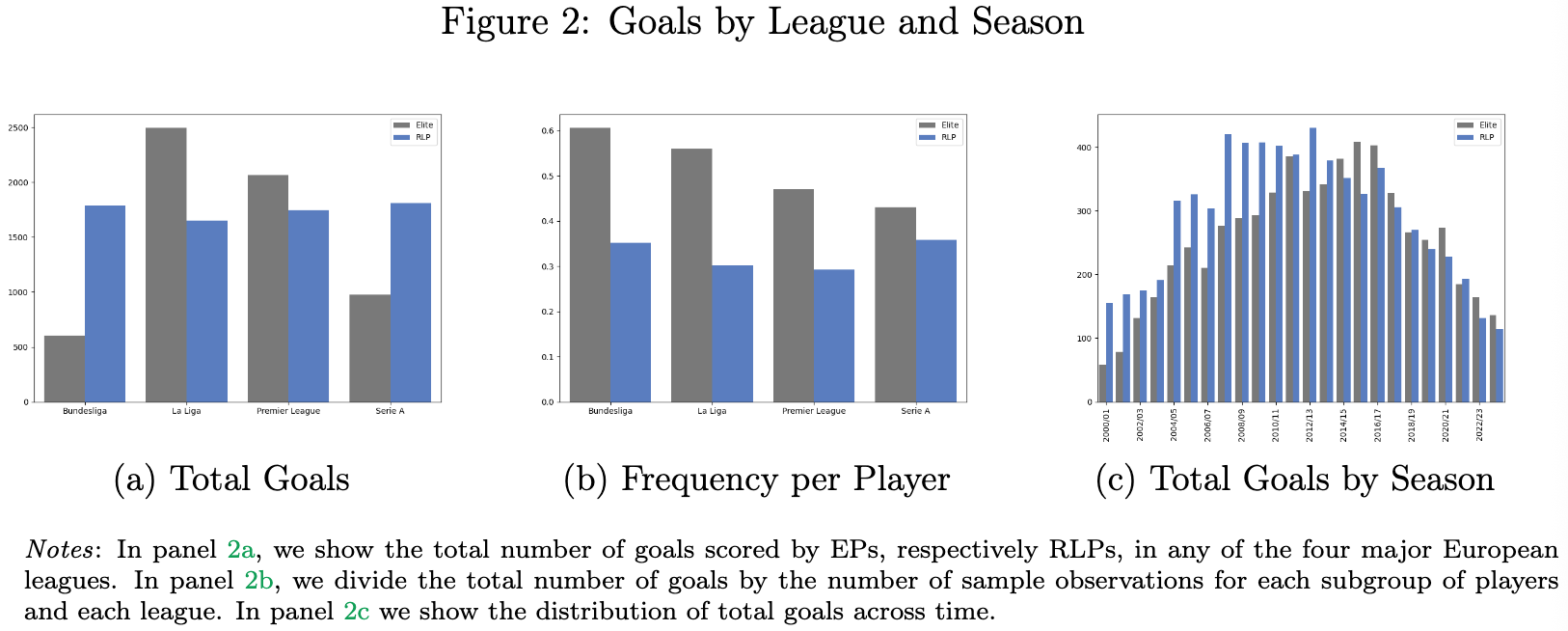
The final SFM uses only two team factors: home advantage and the points difference between the player’s team and the opponent before the match. Other variables were tested but were strongly correlated with points difference. The authors favour the smaller specification because structural interpretability is an important objective, while noting that clubs with richer proprietary data could expand the factor structure.
4.2 SFM Results: Number of Goals Scored per Game
Skill Above Replacement (SAR). Figure 3 compares elite players against the artificial replacement player under equal team conditions. Most have positive SAR estimates, but the Bayesian framework also provides credible intervals around those values.
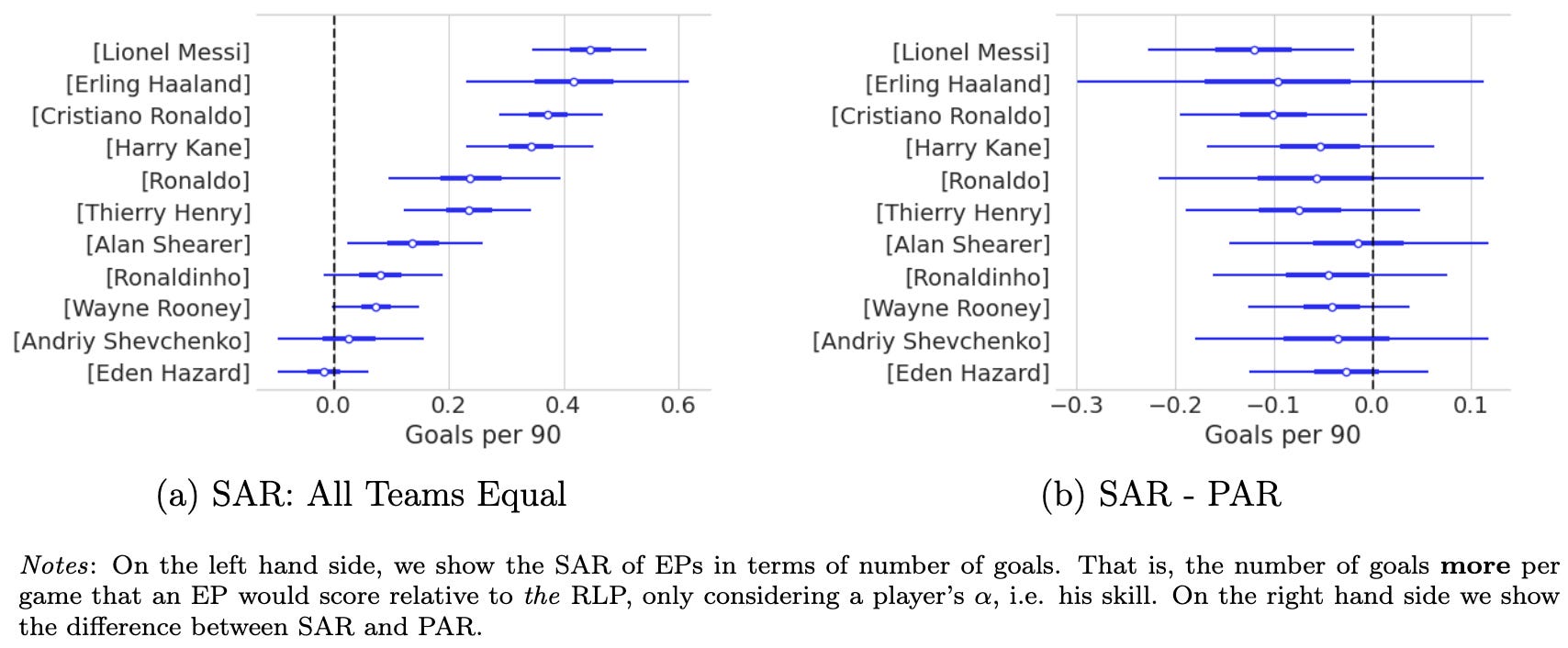
This uncertainty matters when ranking players. Erling Haaland, for example, has a higher mean SAR than Cristiano Ronaldo but a considerably wider interval because of his smaller sample. The model is much more certain about players with long careers such as Ronaldo and Lionel Messi.
Based purely on mean SAR, Messi ranks first, leading the authors to describe him as the “MSOAT (Most Skilled of All Time)” within their analysis.
Performance Above Replacement (PAR)
Comparing SAR with PAR reveals the estimated contribution of team strength. If SAR − PAR < 0, the team environment has boosted observed performance. If SAR − PAR > 0, observed numbers underestimate what the player’s estimated skill would suggest.
Haaland provides a clear example. The SFM considers him exceptionally skilled, but also suggests that Borussia Dortmund and Manchester City amplified his observed scoring output. The top SAR players generally appear to have benefited substantially from their teams, potentially because elite teammates amplify one another or because coaching systems maximise their abilities.
For Messi and Cristiano Ronaldo, the model is sufficiently confident to conclude that team strength boosted observed performance. For most other players, uncertainty makes this distinction less clear. These results should also be interpreted cautiously because team strength is represented by only two factors.
The Maturity Effect
Figure 4 shows nonlinear changes in estimated skill. Within seasons, players tend to start strongly before declining through the middle of the campaign, with a small recovery near the end. The authors summarise this pattern as “start-of-season excitement”, “mid-season blues”, and an “end-of-season sprint”.
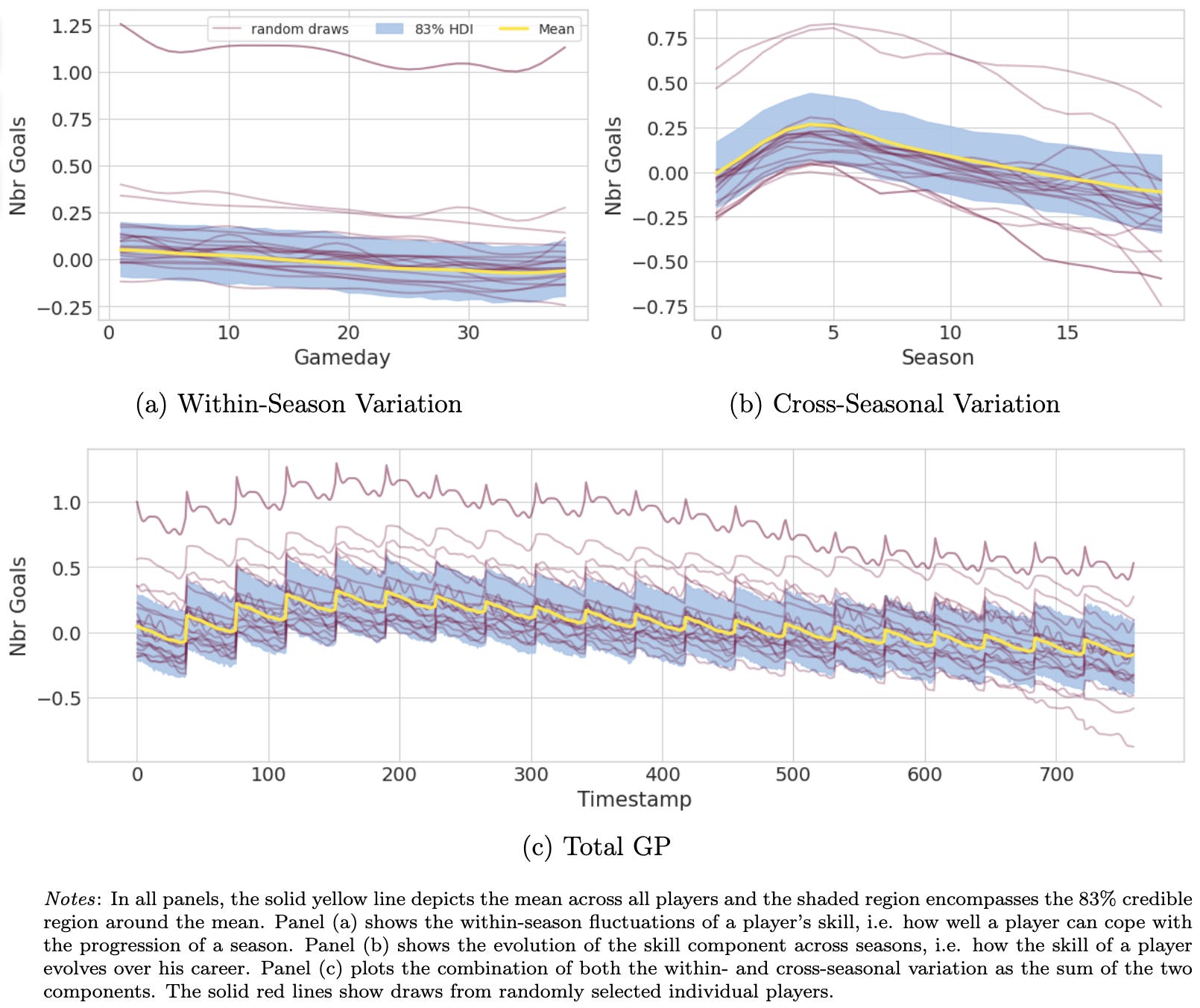
Across seasons, average skill follows a hump-shaped trajectory, peaking around the fourth observed season before gradually declining. Combining both components suggests an average peak after roughly 150 to 250 matches, although individual career trajectories vary considerably.
Forecasting Ability
Finally, the SFM is compared with two simpler benchmarks using leave-one-out cross-validation. One retains the team factors but models player ability as fixed, while the other essentially predicts from each player’s average performance.
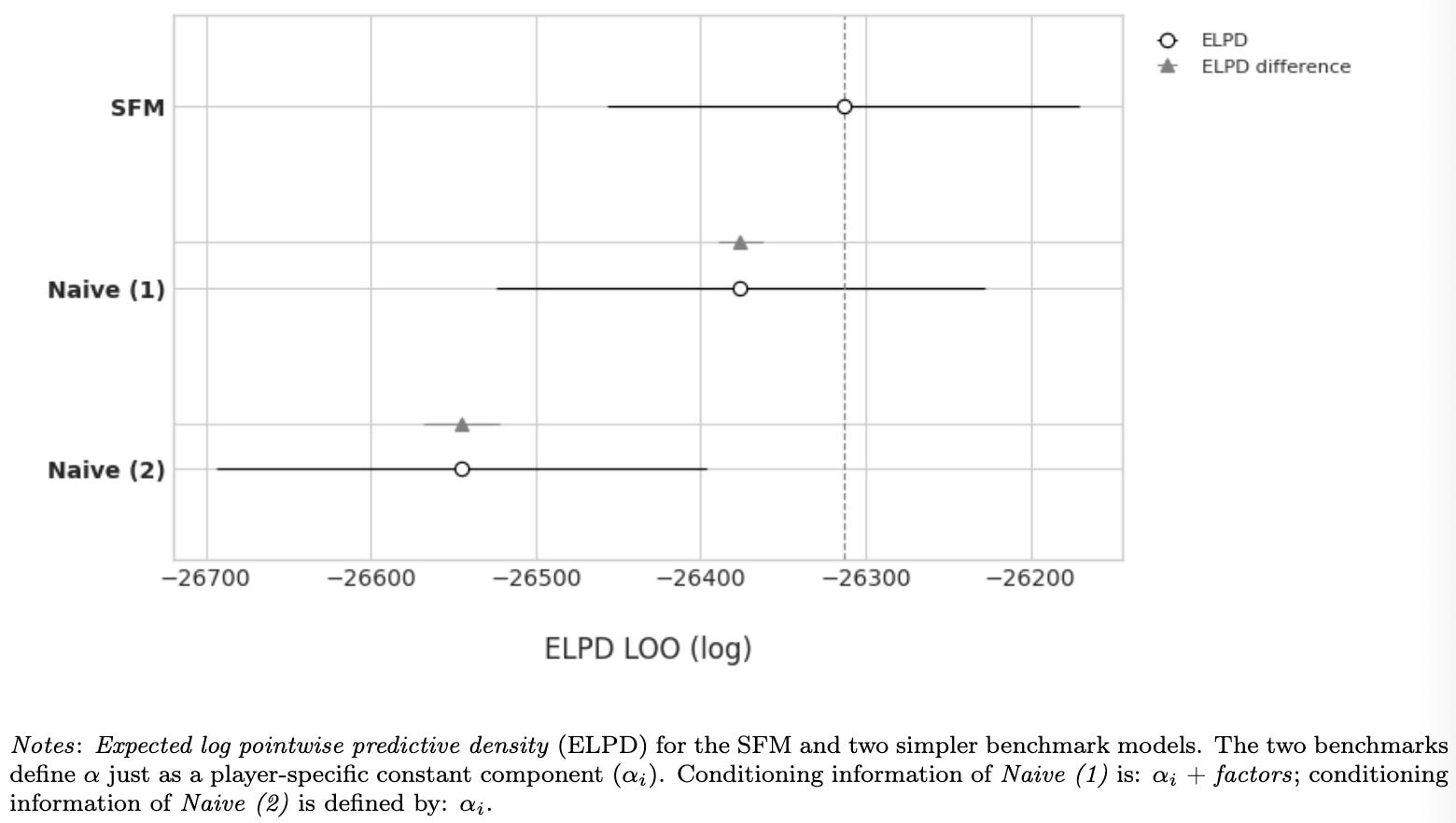
The full SFM performs best. This suggests that both controlling for team strength and modelling nonlinear changes in player skill contribute useful predictive information. However, the authors acknowledge that absolute forecasting performance remains limited, partly because only two team factors are available.
Overall, the empirical results show the main value of the SFM: instead of treating goals as direct evidence of talent, it provides an interpretable framework for estimating how much belongs to the player and how much belongs to the environment around him.
5 Conclusion
The paper introduces the Soccer Factor Model (SFM) to separate individual player skill from the influence of team strength. It also proposes Skill Above Replacement (SAR) and Performance Above Replacement (PAR) to compare players on a fairer basis.
Using more than 33,000 observations from 144 strikers, the model shows that team context can meaningfully affect observed goalscoring performance. The Bayesian framework also quantifies uncertainty around skill estimates.
Finally, the SFM outperforms simpler benchmark models, suggesting that both team adjustment and nonlinear changes in player skill over time improve forecasting and interpretation.
Learn More
Here you have a direct link to get the free xG Mini-Guide, suited for those who want to fully understand the model in 5 minutes.


References
Andorra, A., & Göbel, M. (2024). Unveiling True Talent: The Soccer Factor Model for Skill Evaluation. arXiv preprint arXiv:2412.05911.
https://arxiv.org/abs/2412.05911