


This week we will explore why scoring becomes more likely as matches progress and why the “dangerous minutes after a goal” are more complicated than they seem.
There is an old football cliché that the minutes immediately after a goal are among the most dangerous in a match.
Score, lose concentration, concede. Or score, ride the momentum, and suddenly another one follows.
It sounds plausible. But is there actually something special happening after goals? Or are we simply seeing patterns in a low-scoring sport and giving them a psychological explanation afterwards?
That is the question behind a study that looks at 3,433 matches across 21 leagues and competitions and asks something surprisingly fundamental:
Are goals randomly distributed across a football match?
The answer is no. But the interesting part is why.
The probability of scoring changes as the clock moves
If goals were completely independent of match time, we might expect them to be approximately uniformly distributed across the 90 minutes.
The researchers therefore construct a simple null model: estimate the average goal rate per minute, assume that rate remains constant throughout the match, and simulate six million matches under that assumption.
The observed matches look different.
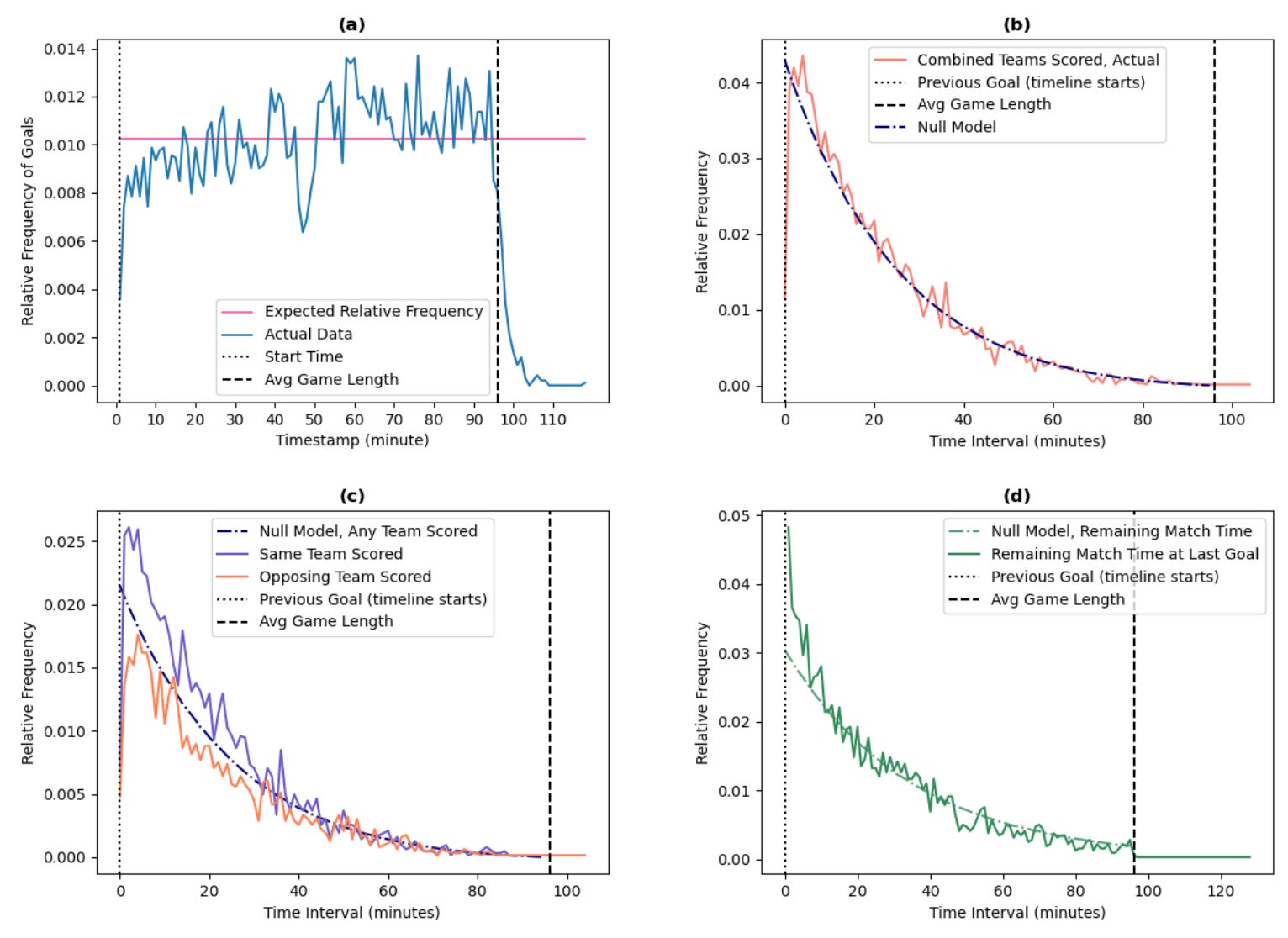
Goal frequency generally increases as matches progress. Goals occur less frequently than expected early in games, and there is another noticeable reduction immediately after half-time. Later periods contain more scoring than a constant-rate model would predict.
The chart below makes the pattern particularly clear: the observed goal frequency begins below the expected level, gradually trends upward and becomes substantially more volatile towards the end of matches.
That makes intuitive football sense.
At 0-0 after ten minutes, both teams still have time. There is relatively little reason to fundamentally alter risk.
At 0-1 with fifteen minutes remaining, the incentives are completely different.
Full-backs push higher. Midfielders take more aggressive positions. Teams press with greater numbers. Defensive structures stretch. Substitutions introduce fresh attacking players. And fatigue may reduce the defending team’s ability to control space.
In other words, football does not operate under a constant attacking environment.
The clock changes behaviour, and behaviour changes the probability of scoring.
But “goals come in bunches” is not enough to prove momentum
Take matches containing at least two goals and calculate how long passes between consecutive goals.
The distribution falls very quickly.
Another goal is much more likely to arrive relatively soon after the previous one than 50 or 60 minutes later. The curve follows something close to an exponential decay.
That initially sounds like strong evidence for the classic football idea of momentum; where one goal changes the game, creating another.
But here the null model becomes important. When the researchers simulate goals randomly using the average scoring rate, almost exactly the same exponential pattern appears.
So simply observing that goals tend to occur relatively close together does not demonstrate that scoring one goal makes another goal more likely.
There is a statistical reason we should expect many short intervals anyway.
Football analysis frequently finds an interesting pattern and then jumps directly to a football explanation. Momentum, confidence, fatigue, pressure.
Sometimes those mechanisms are real, but first we need to ask:
Would this pattern appear even if nothing interesting were happening?
That is exactly what null models are useful for.
