


The following summary critically reviews the research paper titled “Role Vectors: Tracking-Based Representations of Football Players’ Tactical Behavior” by João Henrique Martins, João Paulo Furtado, João Victor Gonçalves, Lucas Mariz, Lucas Santos, Ricardo Furbino, Hugo Rios-Neto, Adriano C. M. Pereira, and Wagner Meira Jr.. All data, figures, and analysis presented here are drawn from their original work; I do not claim any authorship or ownership of the content. This summary has been written to provide a concise and technically informed synthesis of the paper’s findings, methodologies, and implications, while maintaining fidelity to the authors’ intellectual contributions.
1 Introduction
Playing style is difficult to describe with conventional statistics. Pass or shot counts tell us what a player does on the ball, but much of football happens without it: occupying space, supporting teammates, pressing, covering, and recovering defensively. Previous event-based representations such as Player Vectors [4] and SoccerMix [5] therefore capture only part of a player’s tactical behavior.
Tracking snapshots provide the missing spatial context, but absolute position alone can be misleading because the same location may represent different tactical functions depending on team shape. Shape graphs [3] instead describe each player relative to their teammates. Building on this idea, the paper introduces Role Vectors, which aggregate these frame-level tactical roles into season-long player profiles. Each vector describes how often a player occupies different relative roles, with separate versions for in-possession and out-of-possession behavior.
2 Related Work
Player Vectors [4] and SoccerMix [5] showed that event data can produce useful representations of playing style, but their focus remains on direct ball involvement. Tracking data has instead supported role assignment, formation analysis, team-style characterization, pitch control, and tactical features derived from player positioning.
More directly related approaches include 6MapNet [10], which learns latent player embeddings from tracking heatmaps, and SoccerCPD [9], which assigns dynamic roles to detect tactical changes. Role Vectors differ by remaining explicit and interpretable: each dimension corresponds to a recognizable tactical role. The method builds directly on the shape graphs of Brandes et al. [3], extending their frame-level role inference into longitudinal player representations that can also be conditioned on possession state.
More on SoccerCPD:

3 Methodology
Role Vectors are created by transforming event-aligned tracking snapshots into team shape graphs, assigning each outfield player a relative tactical role, and then aggregating those assignments across the season.
3.1 Data
The dataset contains all 380 matches from the 2024/25 English Premier League season, using enhanced event data from Gradient. Each event includes a tracking snapshot with player and ball coordinates. The authors retain frames associated with possession events such as passes, carries, shots, and challenges, while excluding corners because of their distinctive set-piece structure.
Sampling only event moments reduces computational cost but means observations are weighted by event frequency rather than evenly over time. High-tempo phases therefore contribute more frames, a limitation the authors acknowledge.
3.2 Shape Graph Construction
For each frame, a separate graph is constructed for each team after removing goalkeepers. Players form the nodes, while edges are based on Delaunay triangulation and then pruned following Brandes et al. [3] so that the graph captures meaningful spatial relationships between nearby teammates.
The key point is that the graph describes the team’s internal structure rather than absolute pitch coordinates. A centre-back in a very high defensive line can therefore still be represented as a defender relative to teammates, even if their raw location resembles that of a midfielder from another team.
3.3 Relative Tactical Role Attribution
Each player is assigned one vertical and one horizontal zone. The vertical axis contains five levels, from defensive to forward, while the horizontal axis ranges from left to right. Combining them produces 25 possible tactical roles, including positions such as LB, CB, CDM, CM, CAM, CF, and intermediate variants.
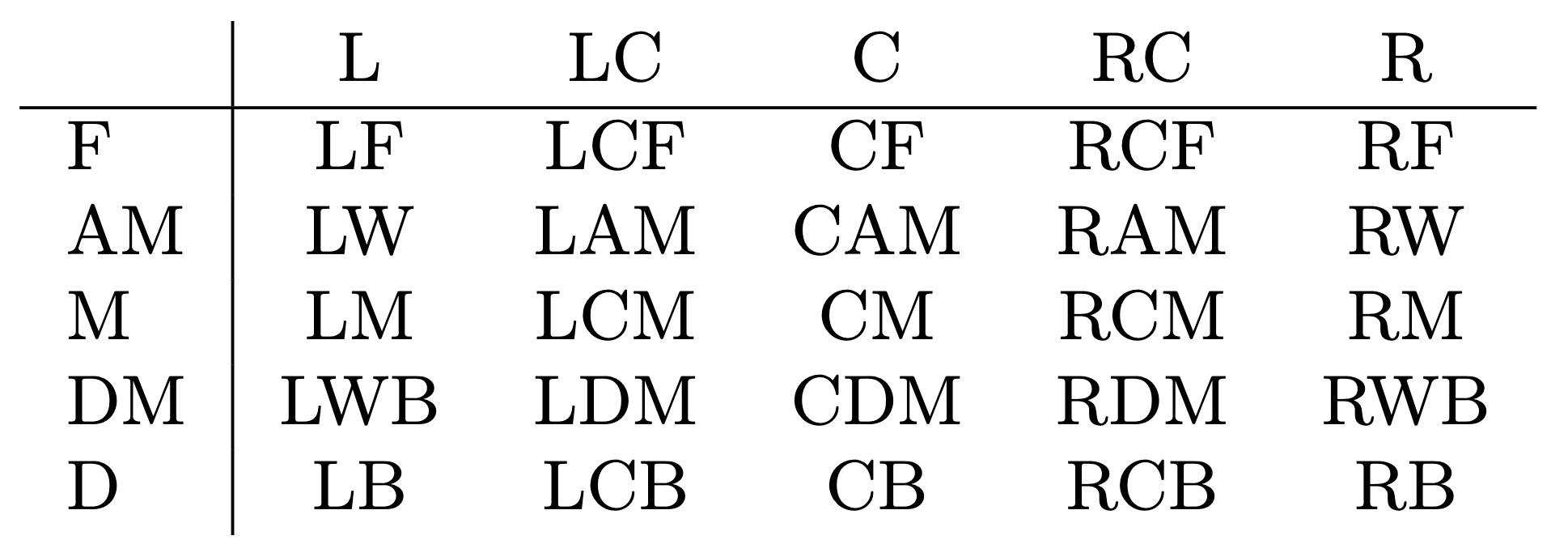
These roles are inferred from the structure of the shape graph rather than fixed pitch zones. This means that a role always describes the player’s position inside their own team shape. For example, CF out of possession refers to the player leading the defensive structure centrally, not necessarily someone standing in a traditional striker location.
3.4 Role Vector Construction
The frame-level assignments are aggregated into a 25-dimensional vector for each player. Every component represents the proportion of observed frames spent in one tactical role, and all components sum to one.
The authors also create separate in-possession and out-of-possession vectors. This allows the representation to capture how a player’s structural role changes between attacking and defensive phases.
4 Results
The evaluation focuses on three questions:
Whether Role Vectors are stable enough to identify the same player across different samples
Whether meaningful positional structure emerges in the vector space
Whether the method can support tactically meaningful player comparison.
4.1 Player Retrieval
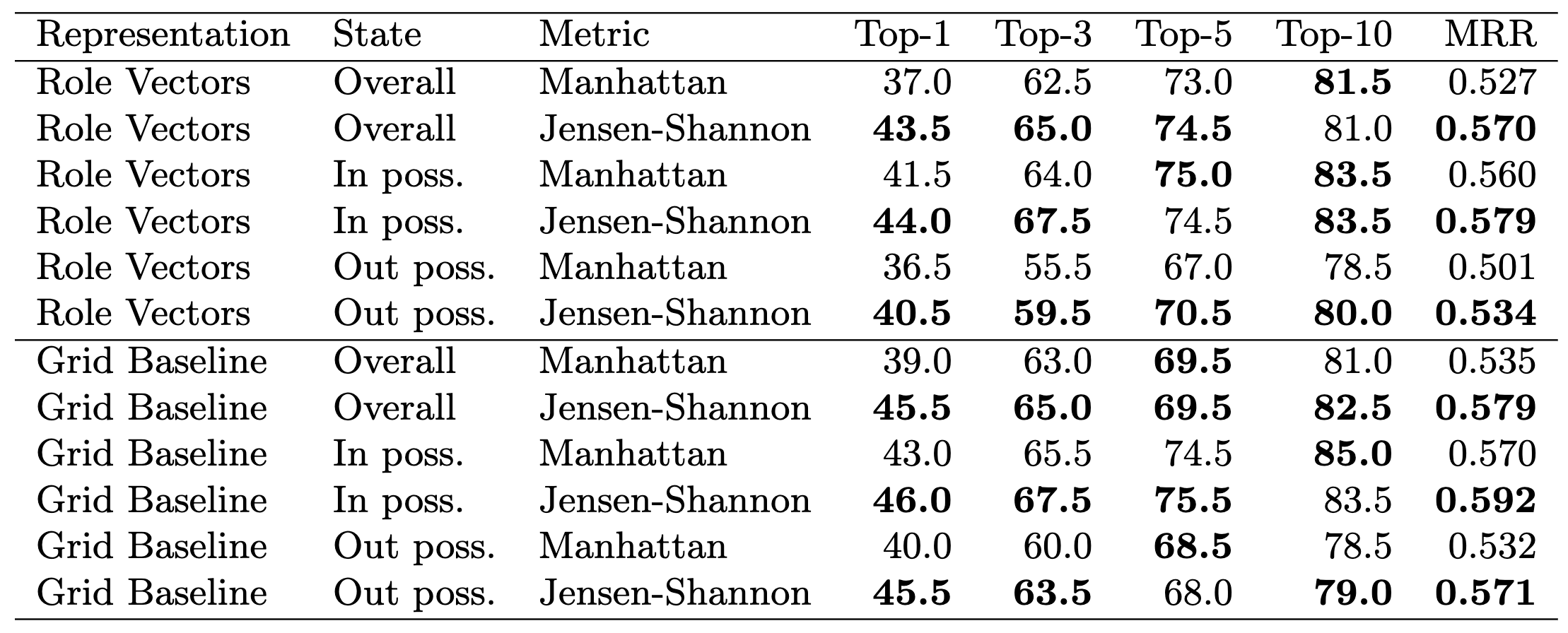
Each player’s matches are divided chronologically into two halves. A Role Vector from the second half is then compared against vectors from the first half, testing whether the same player appears among the nearest neighbors. Only players with at least 900 minutes in each split are included, leaving 200 players.
Similarity is mainly measured using Jensen-Shannon distance, which is well suited to normalized distributions, alongside Manhattan distance. The authors also construct a baseline using a simple 5 × 5 pitch grid, so both methods have the same 25 dimensions.
Both approaches perform far above chance. With Jensen-Shannon distance, Role Vectors retrieve the correct player first in 43.5% of cases and within the top ten in 81.0%. The coordinate baseline performs slightly better on this identity-retrieval task. In-possession profiles are generally the most distinctive, while out-of-possession vectors are somewhat less discriminative, likely because many teams defend in similar compact structures.
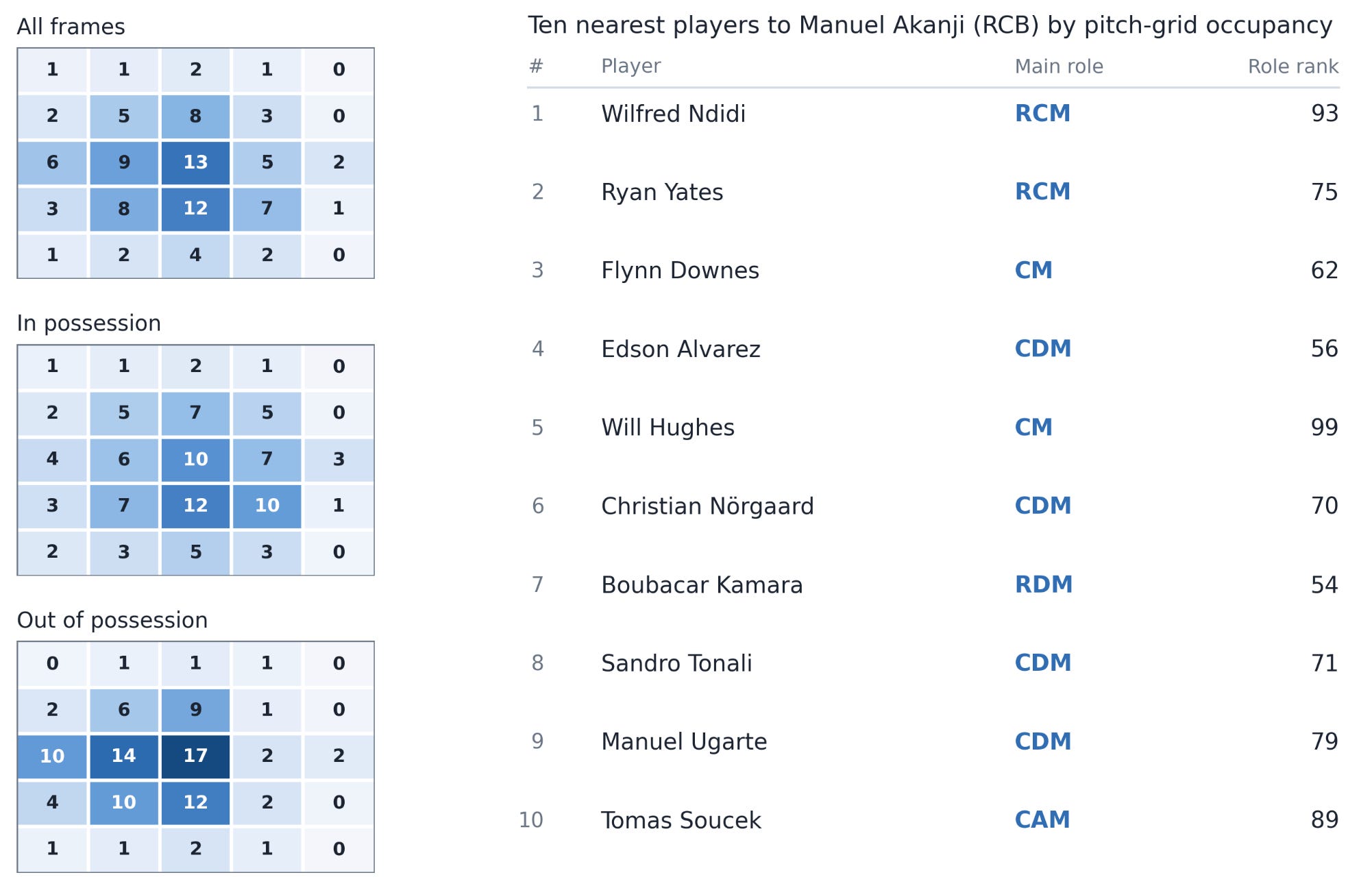
The important difference appears when looking for similar players rather than the same player. Figure 1 uses Manuel Akanji as an example. The coordinate model retrieves midfielders because Manchester City’s high defensive line places him in advanced areas. Role Vectors instead return ten centre-backs among his ten closest matches. As the authors write, “Occupying the same regions of the pitch does not imply playing in the same way.”
4.2 Structure of the Role Vector Space
The authors project the Role Vector space using multidimensional scaling and apply spectral clustering. Without using nominal player positions during construction, the three main clusters align closely with defenders, midfielders, and forwards, suggesting that relative role occupation recovers football’s broad positional structure.
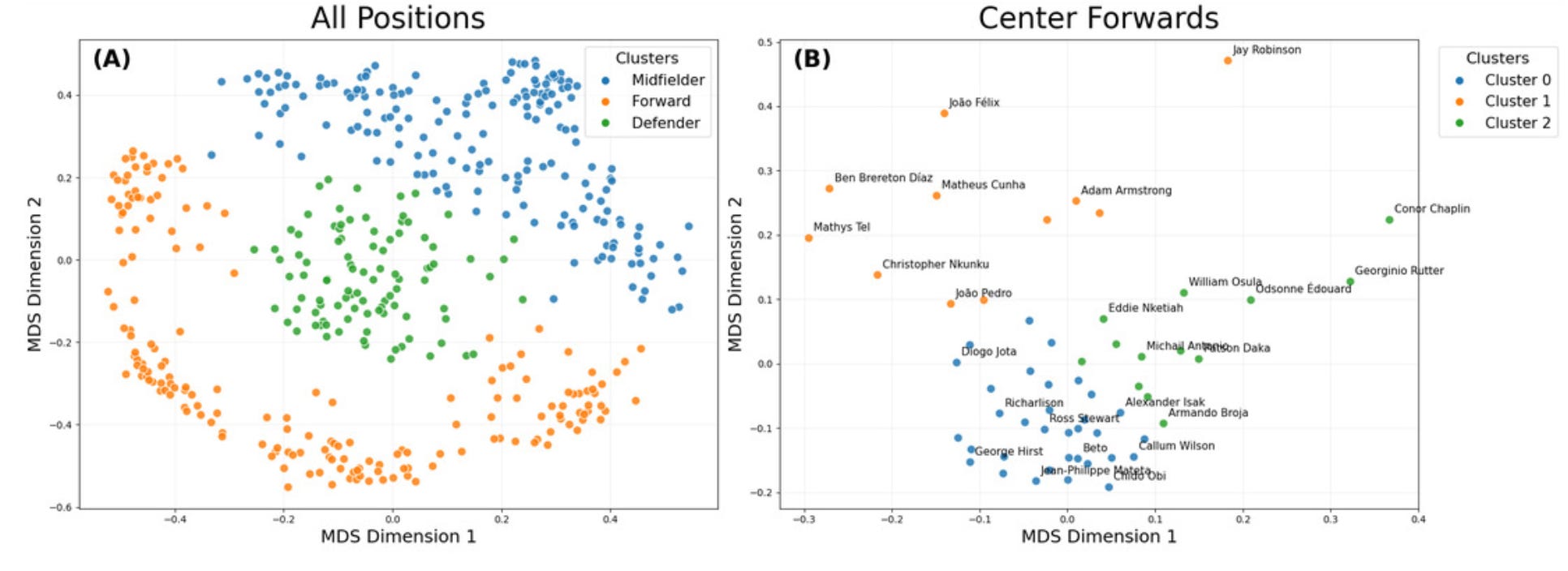
Among centre forwards, most players occupy a compact central area, while smaller groups sit further toward wide attacking roles. This suggests that Role Vectors can distinguish different tactical interpretations of the same nominal position.
4.3 Center-Forward Case Study
The comparison between Rasmus Højlund and Matheus Cunha illustrates this distinction. Højlund’s vector is strongly concentrated around CF, which represents more than half of his observations and becomes even more prominent in possession. Cunha is much more distributed across central, left-central, wide, and attacking-midfield roles. The method therefore represents Højlund as a more specialized central striker and Cunha as a more flexible forward.
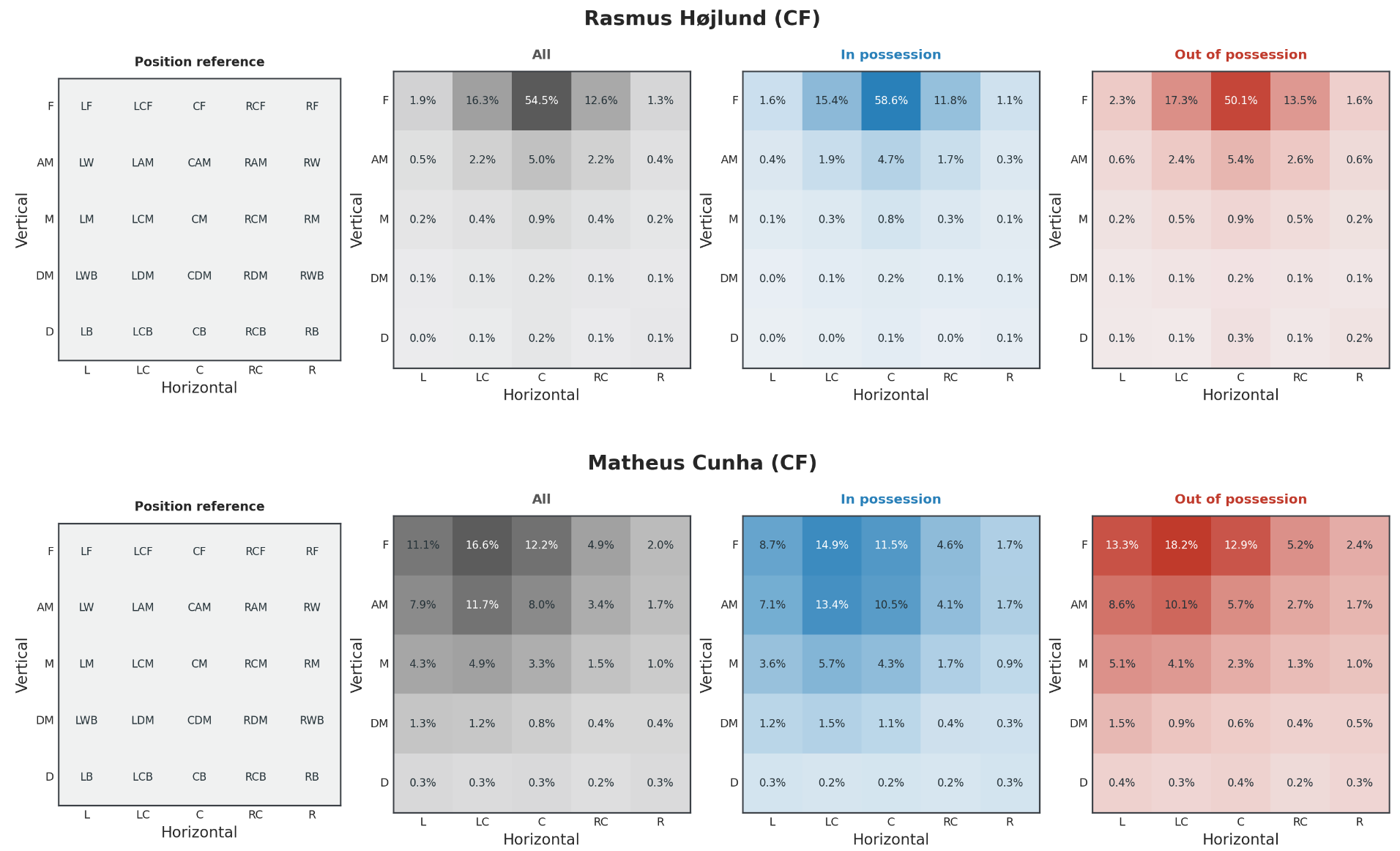
Their nearest neighbors follow the same pattern. Højlund is matched with conventional centre forwards such as Jean-Philippe Mateta, Rodrigo Muniz, Nicolas Jackson, and Erling Haaland. Cunha instead retrieves a more varied group including attacking midfielders and forwards who frequently move into wider areas. This indicates that Role Vector similarity reflects functional role occupation rather than provider-defined position labels.
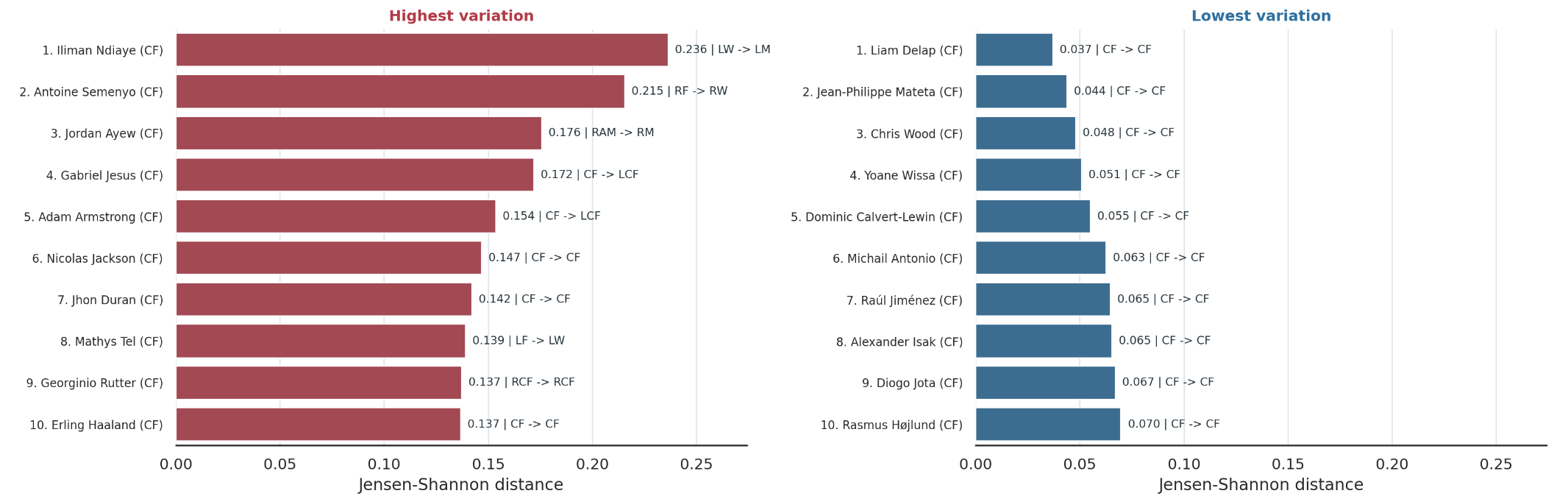
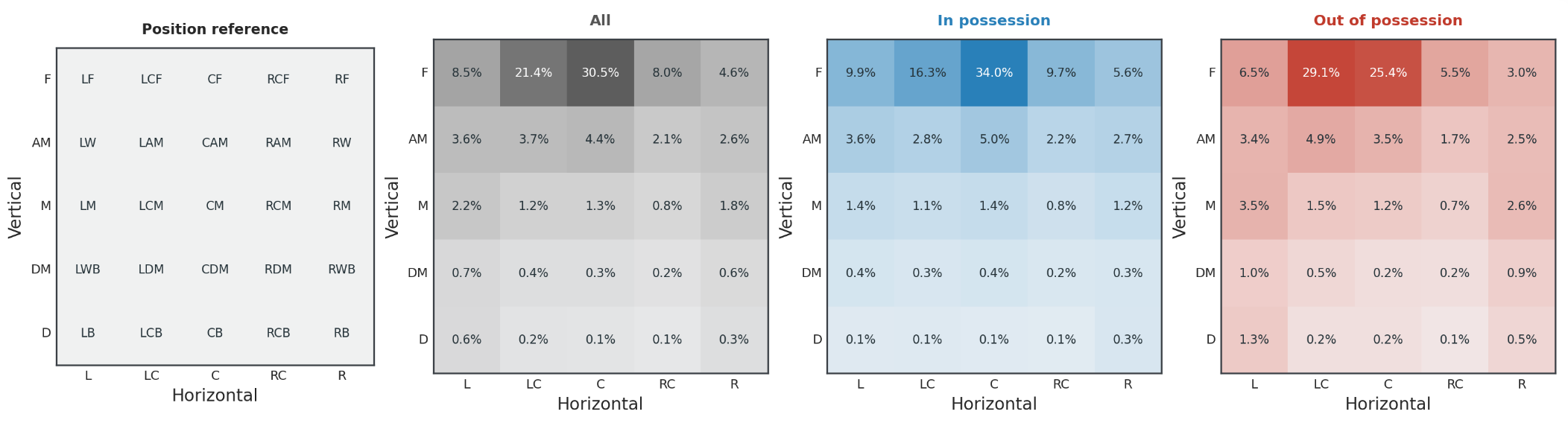
Possession-conditioned vectors reveal another layer. Some forwards, such as Iliman Ndiaye and Antoine Semenyo, change role substantially between possession states, while players such as Mateta and Liam Delap remain much more stable. Gabriel Jesus also shifts noticeably, moving from a mainly central-forward profile in possession toward a left-central-forward role without the ball.
5 Conclusion
Role Vectors provide an interpretable tracking-based representation of how players occupy tactical roles relative to their teammates. Rather than focusing on absolute coordinates or direct ball actions, they summarize off-ball participation within the team’s collective structure and separate attacking from defensive behavior through possession-conditioned variants.
The results suggest that the representation is stable, recovers broad positional structure, and can identify meaningful tactical similarities that absolute-location approaches may miss. Its main limitations are the use of only one league and season, event-aligned rather than continuous tracking, and the fact that player retrieval alone does not prove tactical validity.
Future work could model sequences of role changes, condition roles on context such as pressing intensity, defensive block, scoreline, or match period, integrate actions such as passes and pressures, and apply the framework to continuous tracking data.
Learn More
Here you have a direct link to get the free xG Mini-Guide, suited for those who want to fully understand the model in 5 minutes.


References
Martins, J. H., Furtado, J. P., Gonçalves, J. V., Mariz, L., Santos, L., Furbino, R., ... & CM, A. Role Vectors: Tracking-Based Representations of Football Players’ Tactical Behavior.
https://dtai.cs.kuleuven.be/events/MLSA26/papers/MLSA26_paper_208.pdf